

Contents
Enterprise AI is moving past output. Generating reports and predictions is no longer enough. The focus now is on execution, AI that doesn’t just inform decisions but takes them. This is the era of agentic AI, where autonomous systems begin to redefine how businesses operate and scale.
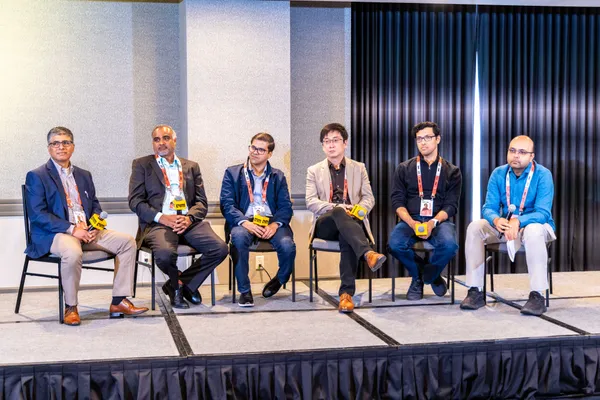
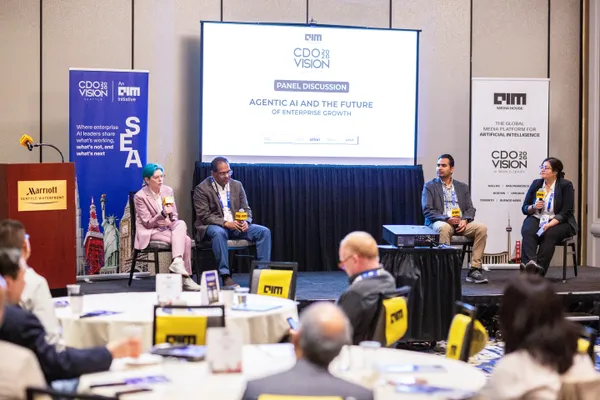
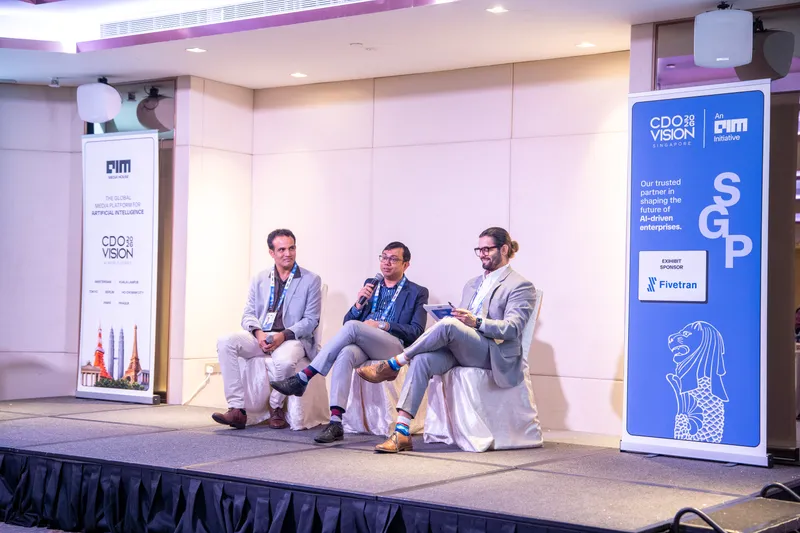
At CDO Vision Singapore 2026, the fifth edition of the Singapore chapter within the CDO Vision AI World Series, a global platform spanning more than twenty cities, enterprise leaders gathered to confront this transformation head-on. A dedicated panel titled "Agentic AI and the Future of Enterprise Growth" brought together Sreenivas Bollina, VP - Data Analytics at ofi and Soumyajit Sarcar, Regional Data Officer at Nomura. Moderated by Sachin B Singh, Head of Enterprise Solutions for the Asia-Pacific region at Dow Jones, the panel explored how enterprises are moving beyond experimentation into real-world deployment of agentic systems.

Sreenivas Bollina
VP - Data Analytics, ofi
Soumyajit Sarcar
Regional Data Officer ( Chief Data Office), Nomura
Sachin B Singh
Head of Enterprise Solutions, Asia Pacific, Dow Jones01Generative AI and action-oriented AI
The panel opened with an honest assessment of where the industry actually stands. Despite the dramatic progress in AI capabilities over the past eighteen months, and the cultural moment represented by viral generative AI outputs, the panellists were candid that the gap between demonstration and production remains significant. As Sarcar observed, flashy demos almost always rely on synthetic or manufactured data. When organisations attempt to deploy similar systems against real enterprise data, the complexity multiplies quickly.
What tends to go underappreciated, both panellists agreed, is not the sophistication of the models themselves, but the foundational work required beneath them: data engineering, system architecture, and governance design. These are the pillars that determine whether an agentic system can be deployed reliably and at scale. Sarcar described these as the most undervalued aspects of the entire AI build, the infrastructure that makes the difference between a compelling proof of concept and a production-ready system.
Partner with CIO Vision
Reach the leaders this piece is about
Four or five partners per room, alongside 50–100 CIOs and enterprise AI leaders. Tell us who you want to meet.
Bollina's organisation spent roughly two years, well before the current agentic AI boom, deliberately building data foundations: re-establishing pipelines, transforming data, and creating a reliable, consolidated data layer that the enterprise could trust. This investment, often invisible from the outside, is precisely what enabled the organisation to move into agentic deployments when the technology matured. The lesson is clear: enterprises that skipped this step are now paying the price in failed pilots and stalled implementations. Agentic AI is not a shortcut, it is the next layer built atop a solid data and architecture foundation.
02Enterprise use cases and the discipline of value realisation
Panellists represented organisations grappling with large volumes of potential AI use cases. Bollina described a dynamic in which the volume of proposals is not the challenge, the challenge is the discipline to filter aggressively. The organisation applies a single, consistent question to every idea: what is the quantifiable benefit? Use cases that cannot translate into a measurable value proposition are deprioritised, regardless of their technical novelty. The result is a concentrated portfolio of initiatives that have a genuine case for ROI.
In practice, this discipline has led the supply chain enterprise to pursue two flagship agentic deployments: a trading digital twin and a supply chain digital twin. The supply chain twin is particularly instructive. The system integrates signals across inventory, production commitments, procurement plans, logistics data, and market intelligence. When a disruption signal arrives, say, instability in a sourcing region, multiple agents collaborate through an orchestration layer to assess downstream impact and generate prioritised recommendations: reallocate production to an alternative facility, prioritise shipments for the highest-value customers, and so on. What previously required weeks of coordination across siloed teams and spreadsheets is now surfaced in minutes. That compression of time is the value the team can point to, and it is the basis on which the ROI conversation is grounded.
At the financial institution, Sarcar described a three-bucket framework for organising use cases: revenue generation and augmentation, productivity and efficiency, and risk management. Client-facing deliverables, such as pitchbooks that previously consumed enormous amounts of analyst time, are now being produced with greater consistency and quality through agentic workflows. The benefit is not merely speed; it is standardisation. Where the same task completed by different analysts would previously yield varying outputs, agent-driven systems apply uniform standards, improving both quality and the client experience.
In risk management, the applications are equally compelling. Know-your-customer processes, trade reconciliations, and trade surveillance, all data-heavy, human-triage-intensive workflows, are areas where agent technology is beginning to make a measurable impact. Sarcar also described deploying agents to uncover data lineage, a task that previously required months or years of manual effort. These are not headline-grabbing use cases, but they represent the unglamorous, high-value work that agentic AI is uniquely well-positioned to handle. The productivity gains, meanwhile, are being deliberately redirected toward higher-value activities, personalised client advice, more holistic engagement, rather than simply being absorbed into the cost base.
03Human-in-the-loop vs autonomous systems
The question of how much autonomy to extend to AI systems and when was a central thread throughout the panel. The consensus was clear: neither organisation is ready to hand over consequential decisions entirely to autonomous agents, and neither expects to in the near term. But the conversation was more nuanced than a simple "not yet."
Bollina described a spectrum based on use case maturity. For decisions that have gone through sufficient iterations and validation cycles, the dependency on human-in-the-loop oversight decreases substantially. For newer or higher-risk use cases, human validation remains essential. Some decisions have already been fully automated, freight bookings and inventory allocation, for instance, where the logic is well-understood and the risk of error is bounded and recoverable. Critically, the learning loop is being embedded into the system: when human reviewers accept or override an agent recommendation, their rationale is captured and fed back into the model, progressively reducing the scope of human intervention for similar decisions in the future.
Ry as a whole is only about a year into a serious agentic journey, and the principle governing this phase is recommendation and augmentation
- Replacement
Ultimately, agentic AI represents something more profound than a new class of software. It represents a fundamental redesign of how enterprises operate, where the boundary between human decision-making and machine action is continuously renegotiated, and where success depends as much on organisational readiness as on technological sophistication. The enterprises that understand this distinction, and invest accordingly, will be the ones that define the next chapter of enterprise growth.
CIO summit Singapore · Compare this with our AI conference for CIOs.