Contents
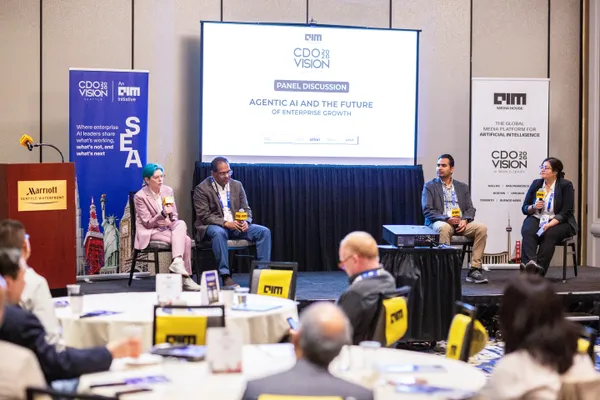
At CDO Vision Dubai 2026, the capstone panel "Agentic AI and the Future of Enterprise Growth" dissected autonomous agents' enterprise journey. The conversation evolved from AI's historical arc to scaling realities, cross-industry trust gaps, and actionable 12-month mandates. What emerged was a consensus that agentic AI scales when business problems drive technology choices, explainability satisfies regulators, and domain-specific IP becomes the unassailable moat.
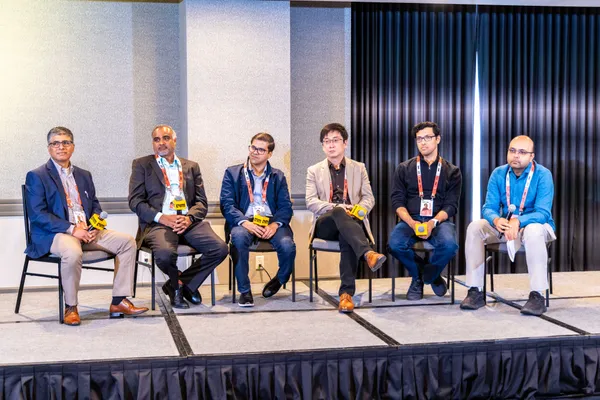
Moderated by Shashank Sridharan, Head of Enterprise Analytics and AI at Allianz Partners, the discussion featured Kirill Lyadov (Chief Data Officer, R-Pharm), Manish Vaidya (Head of AI, Department of Culture and Tourism – Abu Dhabi), Omar Aboutaleb (Data, Digital & AI Leader, Nestlé), and Kader Es Slami (Head of AI & Smart Data Practice, E&). These leaders from pharma, public sector, CPG, and telecom confronted agentic AI's core tension. Lab brilliance vs. production accountability.

Shashank Sridharan
Head of Enterprise Analytics and AI, Allianz Partners
Kirill Lyadov
CDO, R-Pharm
Manish Vaidya
Head of AI, Data & AI Department | Strategic Affairs, Department of Culture and Tourism – Abu Dhabi (DCT Abu Dhabi)
Omar Aboutaleb
Data, Digital & AI Transformation Leader, NestleAgentic AI's Core Shift
Enterprise AI has progressed through distinct phases. Early systems provided decision support, requiring humans to interpret outputs and explain reasoning. Predictive analytics demanded "why" justifications for forecasts. Now agentic systems autonomously handle "what's next," generating decisions from generative models while humans decode the black-box logic.
This inversion creates governance challenges. Public sector applications mirror banking's explainability requirements but amplify accountability, policy recommendations must trace reasoning across multi-step workflows. Enterprises face parallel demands: agents must not only decide but justify actions amid non-deterministic behavior.
Partner with The CIO Room
Reach the leaders this piece is about
Four or five partners per room, alongside 50–100 CIOs and enterprise AI leaders. Tell us who you want to meet.
The panel noted a key evolution that documents and unstructured content now function as "data," powering knowledge activation that was theoretically possible but practically unfeasible until recent foundation model advances.
POC-to-Production Barriers
Industry surveys confirm the stark reality that most agentic pilots achieve lab success but fail scaling. Production introduces non-technical hurdles like brand risk from network-level errors, legal/compliance scrutiny, and stakeholder coordination across security teams. Lab metrics like accuracy or optimization lose relevance when hundreds of users interact with live systems.
Recent CEO surveys reveal exhaustion with incremental gains. After years of robotic process automation investments yielding workflow tweaks, executives now demand transformation-level ROI. Agentic AI requires extra-budget justification beyond operational savings, positioning it as strategic investment rather than tactical automation.
Scaling demands production readiness from day one: observability frameworks tracking drift, cost controls monitoring token consumption, and traceability ensuring auditability.
Cross-Industry Implementation Challenges
Consumer packaged goods firms grapple with distribution optimization across sales, marketing, supply chain, and finance. Agents replace cross-functional meetings by autonomously recommending products, geographies, and trends, but external data from distributors and retailers erodes trust. Stakeholders validate outputs despite superior speed and accuracy, creating a governance paradox, higher performance increases human oversight burden.
Pharmaceutical organizations build layered agent architectures, simple action engines evolve into multi-agent orchestrators handling executability checks, complexity validation, and traceability. Knowledge graphs activate proprietary insights, transforming documents into actionable intelligence.
Telecom enterprises face acute brand stakes, a single network agent's failure ripples across customer experience. Global operations spanning multiple regions demand federated data approaches, balancing centralized governance with localized execution. The panel challenged data maturity assumptions. Enterprises invested decades building fabrics and federation across worldwide operations.
Governance and Trust Foundations
Success hinges on business ownership
- Technology leadership
Trust emerges through observability: real-time data consistency, drift detection, cost transparency, and access controls. Workforce adoption accelerates when employees co-create solutions, viewing agents as augmentative rather than displacing.
Boards require education to shift perceptions from cost centers to transformation engines. Executives must embrace experimentation timelines exceeding traditional ROI expectations, similar to internet adoption, where early specialists paved paths for mass accessibility.
Closing Action Plan
The panel converged on three interconnected imperatives for the next 12 months. First, experiment aggressively. Technology adoption follows hype cycles, fail fast in controlled R&D environments. Early capabilities that disappointed return viable as agentic systems mature.
Link every initiative to measurable outcomes
- Operational efficiencies
Third, secure domain IP. Train agents on proprietary data patterns representing true competitive edges. Domain-specific knowledge nodes cannot be outsourced; they define sustainable advantage.
CIO summit Dubai · Compare this with our AI conference for CIOs.