Contents
Enterprises rarely struggle to make decisions. They struggle to preserve the reasoning behind them. At scale, choices are translated into workflows, controls, systems, and automation layers where intent thins out quickly. Once execution begins, the judgment that informed the decision fades into logs, approvals, and fragmented records. What remains is an outcome without lineage. This gap usually stays hidden until a regulator asks a question, a customer dispute escalates, or leadership needs to explain why a system acted the way it did.
That structural weakness becomes harder to ignore as agentic AI moves from experimentation into daily operations. These systems are designed to act across processes, trigger downstream steps, and respond continuously to change. Efficiency improves, but the distance between decision and explanation widens. When something breaks, enterprises often discover they can show what happened but not defend why it was reasonable at the time.

Umesh Kumar
Chief Analytics Officer, Delta Dental of New Jersey and Connecticut
Alessandro Petroni
Head of Data Engineering, The Clearing House
Maharaj Mukherjee
Senior Vice President and Senior Architect Lead, Bank of America
Michael Shaw
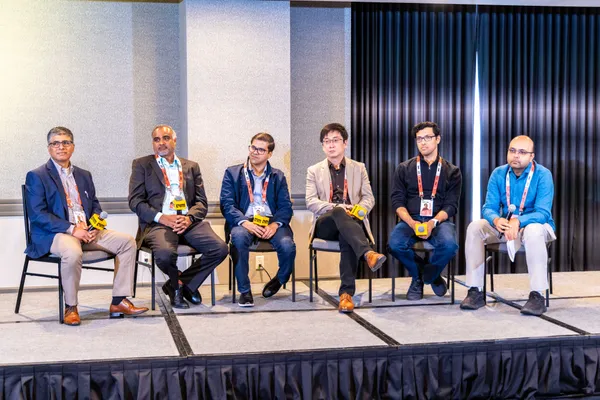
SVP Data and AI, Dow JonesAt CDO Vision New York 2026, we had seasoned leaders talking about Agentic AI and the Future of Enterprise Growth who examined this problem through execution rather than ambition. The discussion brought together Umesh Kumar, Chief Analytics Officer at Delta Dental of New Jersey and Connecticut; Alessandro Petroni, Head of Data Engineering at The Clearing House; Maharaj Mukherjee, Senior Vice President and Senior Architect Lead at Bank of America; Michael Shaw, SVP Data and AI at Dow Jones; and was moderated by Julia Cherashore, Senior Fellow at the Data Foundation. The conversation focused on operational reality, focusing on how autonomous systems are introduced inside complex enterprises and what that reveals about how decisions are governed after they leave human hands.
01Autonomy expands faster than accountability
In industries, AI adoption starts when operational pressure builds. Transaction volumes increase, and customers begin expecting real-time service. Manual processes stick around because regulations have traditionally relied on human checkpoints. But as scale grows, that balance starts to break.
Partner with The CIO Room
Reach the leaders this piece is about
Four or five partners per room, alongside 50–100 CIOs and enterprise AI leaders. Tell us who you want to meet.
Agents appear first, where they remove invisible labour while keeping oversight intact. Systems monitor data pipelines, flag anomalies, translate documents, prepare claims, and surface decisions for review. Humans continue approving the final steps. This pattern shows accountability boundaries rather than technical limits.
Autonomy grows incrementally. Organisations move from manual execution to assisted workflows, then toward partial delegation supported by sampling and review. Sensitive decisions remain shaped by governance exposure. Competitive pressure pushes teams to move quickly, though skipping stages produces brittle systems. Tools look advanced while remaining detached from how work actually happens. More critically, they create decision paths that resist explanation later.
Enterprises begin governing the context itself. Semantic definitions, assumptions, policy constraints, and operating conditions become part of the decision surface. Without this structure, agents act correctly while producing outcomes that the business struggles to defend. This is an old pattern. Decisions treated as moments rather than assets dissolve into logs and approvals that show sequence without intent.
02When decisions lose their memory
Responsibility remains human, yet accountability relocates. Technology and data leaders become answerable for business outcomes once buffered by manual review. That raises expectations for traceability. Systems must show which inputs informed a decision, which rules applied at that moment, and why one path emerged over another.
This pressure changes how systems are built. Decisions need the ability to be replayed, and context must be preserved. Ownership models start to look like the data stewardship structures that came with large-scale analytics platforms. Some processes, however, are not ready for full automation. Human judgment remains essential where interpretation, ethics, or legal risks are involved.
Agentic AI often enters boardroom conversations as a growth lever. Its more immediate impact runs deeper. It forces organisations to confront how decisions travel, how reasoning survives execution, and how accountability functions once systems act continuously.
Execution is already largely automated. Agentic AI speeds up what’s already happening rather than creating entirely new dynamics. Organizations that focus on preserving reasoning, context, and traceability are better prepared when scrutiny arrives. Without clarity, speed alone can turn efficiency into risk.
CIO summit New York · Compare this with our AI conference for CIOs.