Contents
Agentic AI represents a fundamental departure from the AI systems enterprises have grown accustomed to , moving beyond tools that respond to prompts toward systems that autonomously plan, decide, and act across complex business workflows. Where traditional AI augments human decision-making, agentic AI increasingly steps into the operational fabric of organizations, executing multi-step tasks, navigating ambiguity, and driving outcomes with minimal human intervention. But unlocking that potential at enterprise scale is proving to be as much a strategic and organizational challenge as it is a technical one.
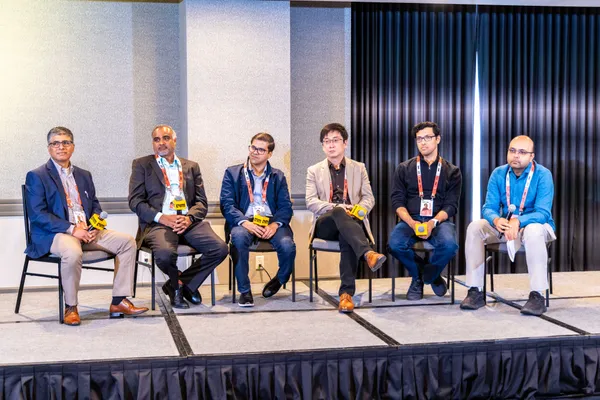
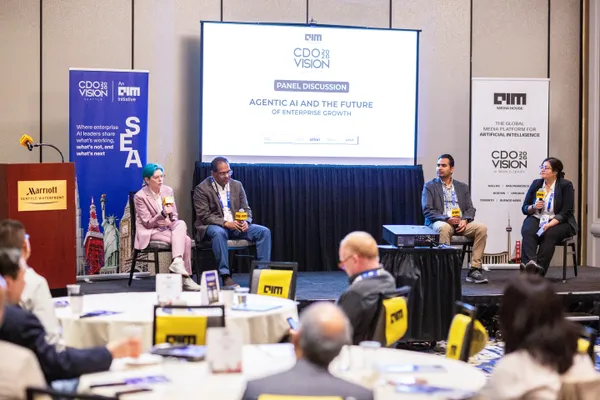
It was against this backdrop that CDO Vision London , part of the CDO Vision AI World Series, a global initiative spanning 22 cities that brings together senior data and technology leaders to explore the frontiers of AI-driven business transformation , hosted a panel of industry leaders to explore exactly that tension. Insights from experts including Gerald Schmidt of DS Smith, Nitesh Jain of C5, Shantanu Lodh of Allvue Systems, and Ayo Babajide of Flutterwave illuminated what it truly takes to move agentic AI from promising prototype to scalable enterprise capability.

Gerald Schmidt
Head of Engineering for Digital & Data, DS Smith
Nitesh Jain
Chief Executive Officer, C5i
Shantanu Lodh
Head of AI Architecture, Allvue Systems
Ayo Babajide
Head of AI and Data, Flutterwave01Agentic AI = operating model, not just technology
One of the most persistent misconceptions surrounding agentic AI is that it is simply a more powerful version of the automation tools enterprises have long relied upon. The panelists were unequivocal in pushing back against that framing. Agentic AI is not a technology solution dropped into an existing workflow , it is an operating model evolution, one that demands organizations fundamentally rethink how decisions are made, who holds accountability, and how processes are designed from the ground up.
Nitesh Jain put it, throwing agents at broken processes will not make those processes work better. It will simply make them fail faster, and at greater cost. Before any agent is deployed, organizations must map their current processes with precision, identify where inefficiencies are structural rather than operational, and reimagine the workflow entirely before introducing automation. Without that groundwork, even technically sophisticated agentic systems will stall at the point of enterprise adoption.
Partner with The CIO Room
Reach the leaders this piece is about
Four or five partners per room, alongside 50–100 CIOs and enterprise AI leaders. Tell us who you want to meet.
Equally important is the discipline of defining clear business outcomes before reaching for the technology. As several panelists noted, the excitement surrounding agentic AI often leads organizations to prioritize deployment over purpose , a reversal that consistently undermines impact. The enterprises seeing genuine returns are those that have asked the harder question first: not what can agents do, but what specific outcome are we trying to drive, and is our organization structurally ready for AI to influence or execute that decision.
02Scaling challenges , architecture, cost, and integration
Moving from a successful agentic AI pilot to an enterprise-wide capability is where ambition most frequently collides with reality. The barriers are rarely about model performance , they are structural, financial, and architectural, and they compound quickly as organizations attempt to move beyond isolated use cases toward systematic deployment across business functions.
Legacy systems and accumulated technical debt represent perhaps the most stubborn obstacle. Large enterprises operate across sprawling technology stacks built over decades, and ripping and replacing them in pursuit of AI readiness is neither practical nor financially viable. Instead, as Nitesh Jain observed, the more sustainable path lies in composable architectures , integration layers designed to work alongside existing enterprise infrastructure, modernizing progressively rather than wholesale. Without that foundation, agents hit boundaries they cannot traverse, and orchestration breaks down precisely where it matters most.
Gerald Schmidt was direct on this point: agentic AI initiatives must demonstrate a credible route to profitability
- Merely technical promise
Ultimately, scaling means graduating from experimentation to enterprise capability , where agents are not deployed ad hoc but orchestrated systematically, governed consistently, and evaluated continuously against measurable business outcomes. That transition requires as much organizational alignment as it does architectural readiness.
03Governance, trust, and the human factor
S pinned model versions, tool limitations, and output constraints directly into CI/CD pipelines so that compliance is enforced at build time
- Reviewed after the fact
Equally important is the question of where humans remain in the loop, and why. Nitesh Jain emphasized that process redesign must explicitly define the handshake points between agent and human , moments where accountability transfers, judgment is required, or risk thresholds demand intervention. Observability is the connective tissue that makes this possible, giving organizations the visibility to trust what their agents are doing and the mechanisms to course-correct when they do not.
For the workforce, the conversation is less about replacement and more about reorientation. Ayo Babajide captured the emerging pattern clearly: as AI absorbs routine analytical and operational tasks, human teams are freed , and expected , to move toward more strategic, higher-judgment work. The skills in demand are shifting toward prompt engineering, knowledge curation, and AI oversight. The organizations building trust internally are those that frame this not as a threat, but as an invitation to evolve.
04The future of agentic AI
The next frontier of agentic AI extends well beyond the digital workflows enterprises are only beginning to master. Ayo Babajide pointed to multimodality as the defining characteristic of what comes next , agents operating fluidly across text, video, audio, and increasingly the physical world, moving from decisions made on screens to actions taken in real environments.
The pace of that shift is unlikely to be gradual. Nitesh Jain's example of a beauty company scaling from 50 product concepts per year to 500 concept tests per month illustrates what continuous learning loops already make possible today. What feels ambitious now will become baseline expectation within years, not decades.
For enterprise leaders, the imperative is clear: preparation cannot wait for the technology to fully mature. Organizations that invest now in the right architectural foundations, talent capabilities, and governance frameworks will be positioned to lead. Those that wait to react will find themselves perpetually catching up.
CIO summit London · Compare this with our AI conference for CIOs.