Contents
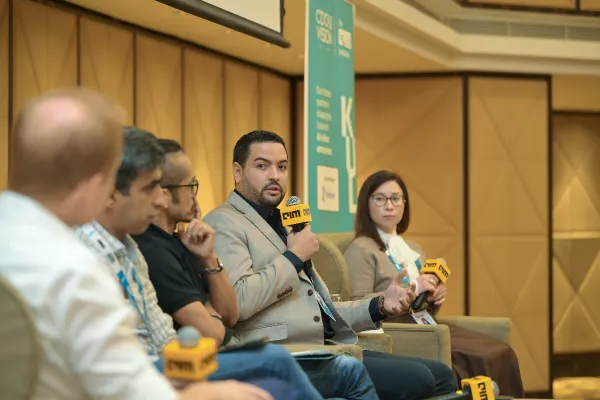
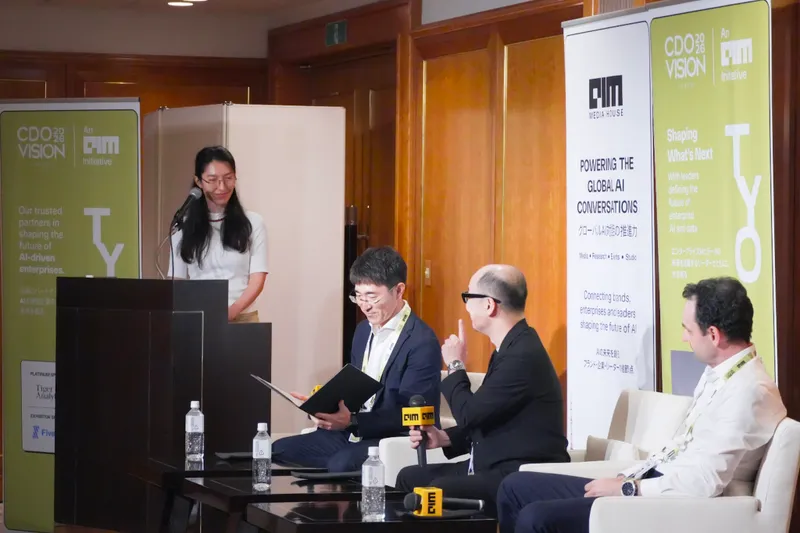
At The CIO Room Tokyo, leaders from pharmaceuticals, consumer goods and software quality assurance agreed on one thing: the model is not the moat. Data, governance and the courage to delegate are.
His background is analytical science
- AI, and he sits outside IT

Tomokazu Tajiri
Head, Analytics & Digital Innovation, Technology Scouting & Integration Labs, Astellas Pharma
Masayuki Kubo
Head of Advanced Technology Research Lab / Vice President of AI Strategy, Pole To Win Holdings, Inc.
Rasool Aghdam
Head of Commercial Data Analysis & Science, Coca-Cola Bottlers Japan Inc.That framing shaped a discussion that stayed refreshingly practical. Alongside him were Masayuki Kubo, Head of Advanced Technology Research Lab and Vice President of AI Strategy at Pole To Win Holdings, who is using agentic AI to modernise legacy systems, and Rasool Aghdam, Head of Commercial Data Analysis & Science at Coca-Cola Bottlers Japan, who brings a PhD in privacy-preserving technologies and years of building end-to-end data products.
From prompt-driven to goal-driven
Asked to name the single biggest change agentic AI will bring to the enterprise, Aghdam pointed to a shift that is already under way: from prompt-driven AI to goal-driven systems.
"That's a really big enabler," he said. Instead of asking a model one question at a time, enterprises will start delegating whole tasks to AI agents, with proper controls and guardrails in place, and have the job "done end to end and reported back."
Partner with The CIO Room
Reach the leaders this piece is about
Four or five partners per room, alongside 50–100 CIOs and enterprise AI leaders. Tell us who you want to meet.
Kubo, whose firm is known for game debugging, software testing and quality assurance, said his teams are already seeing large gains in development productivity from AI-driven development and agent-led modernisation of legacy code.
When models become commodities, what's left?
Tajiri's next question went straight to strategy: if foundation models become a commodity, where does competitive advantage come from?
Kubo's answer was that it never really came from AI in the first place. An enterprise's edge lies in what it already offers: its operational model, the knowledge it has built up, and its position with customers in the market. AI amplifies those assets; it does not replace them.
Aghdam agreed, and brought it down to three fundamentals: your data, your context and your controls. He was candid about the first. "We don't have clean data, we don't have clean master data," he said. "We have to do a lot of work to actually bring that quality to the level that we need." Without it, agents will not deliver the accuracy anyone expects.
Context, he added, is not always in a database. Often it lives "in the head of your domain experts" who have been doing the job for 20 or 30 years. Capturing that tacit knowledge, and wrapping it in the right controls, is what turns a commodity model into an enterprise advantage.
Productivity tool, or execution engine?
What does agentic AI ultimately become inside the enterprise: a productivity tool, a growth engine, a decision-intelligence engine, or something else?
Kubo described it as infrastructure: a workflow management system, closer to an operating system for the business. AI can feel abstract, he noted, so the real work is to organise and structure it simply, and deliver it simply.
Aghdam's view was that it can become all of these, but at different stages for different companies. The assistant stage is already well established, especially in coding. He shared a telling anecdote: his team recently lost an API key at the last minute and realised that without model access, the work would be delayed. "So now there is a real dependency there."
The missing piece, he argued, is AI as the actual execution engine: getting things done "in a way that it's supposed to be done and as fast as it's supposed to be done." The potential is there; the controls around it are what still need building.
The 50% vs. 20% question
The sharpest moment of the session came when Tajiri posed a trade-off: would you take a 50% productivity improvement, or a 20% improvement in strategic decision-making?
All three leaned towards better decisions, for different reasons.
For Tajiri, the arithmetic in pharma is clear. A critical study can cost around a billion dollars per project, so saving a thousand hours of effort matters far less than getting the decision right.
Kubo made the case through compounding. A poor strategic decision does not stay contained; its mistakes are "intensified exponentially throughout every subsequent process." Improving decision quality at the executive and leadership level, he said, delivers far greater benefit over time than operational speed.
Aghdam also chose decisions, with a caveat every CFO will recognise: you won't be able to measure that 20% anytime soon. Strategic decisions take months or years to prove themselves, while a 50% productivity gain "is kind of cash to me." His resolution was pragmatic: "AI agents are not greedy." Enterprises ready to use them well can have both.
The real bottlenecks: governance, data and trust
What stops enterprises from scaling agentic AI? Kubo, whose team helps organisations roll out enterprise AI, pointed to the gap between an individual using an LLM and a company deploying AI across the organisation. The governance required is completely different.
That means clear policies on what level of confidential information employees may enter and under what conditions, who in the organisation is authorised to use AI, and which business processes are appropriate for it. Without that framework, scale stalls.
Aghdam named two further bottlenecks. The first is data quality, which ultimately supplies the context and semantics agents need. Part of his data is clean enough to work with, he said; the rest requires investment in data platforms and in the processes that keep quality high.
The second is reliability. He cited platform surveys in which around 70% of technical users reported major productivity gains, yet the same surveys showed trust in AI outputs declining. The headlines about AI mistakes, he suggested, are a symptom of the same problem.
Privacy is a legal problem and a technical one
Aghdam then turned the question to Kubo: how can enterprises actually address privacy and reliability?
Kubo's answer was that it has to be approached from two directions at once. On the legal side, data collected from consumers needs proper consent so the organisation stays compliant with applicable laws. On the technical side, data must be processed before AI ever touches it: sensitive information anonymised and masked to meet legal requirements. Unless both are addressed, he said, data security cannot be adequately assured.
A postcard from 2030
To close, Tajiri asked the panel to imagine meeting again in 2030. What will enterprises still be doing today that will look completely irrational in the age of agentic AI?
Kubo expects the confusion and hype around AI to have faded considerably. In its place: AI used in a way where humans remain in control, able to see, manage and oversee the entire process.
Aghdam's prediction was more specific, and probably familiar to everyone in the room. The manual business-intelligence loop of collecting data, building dashboards and Excel files, pasting them into a PowerPoint and sending it to someone to make a decision "will definitely change by 2030." He also expects more headlines and more mistakes along the way, and sees that as part of progress: "Without making those mistakes, I don't think we will advance anyway."
The model isn't the moat.
Advantage comes from your operational model, proprietary knowledge, data, context and controls.
Fix the data first.
Clean master data and captured domain expertise decide whether agents are accurate or merely fast.
Govern before you scale.
Enterprise AI needs explicit rules on data, users and use cases that individual AI use never required.
- The model isn't the moat. Advantage comes from your operational model, proprietary knowledge, data, context and controls.
- Fix the data first. Clean master data and captured domain expertise decide whether agents are accurate or merely fast.
- Govern before you scale. Enterprise AI needs explicit rules on data, users and use cases that individual AI use never required.
- Treat privacy as both legal and technical. Consent and anonymisation have to work together.
- Aim at decisions, not just hours. Productivity gains are easy to bank; better strategic decisions compound.
- Keep humans in the loop. The 2030 vision is not humans removed, but humans overseeing end-to-end agentic work.
Join the conversation at The CIO Room
This discussion is one of many candid, practitioner-led sessions at The CIO Room, an invite-only boardroom series bringing together senior technology, data and AI leaders across 20+ cities worldwide.
For CIOs, CDOs and AI leaders: request an invitation to an upcoming CIO Room in your city at thecioroom.com.
For solution providers: partner with The CIO Room to put your platform in front of the enterprise decision-makers shaping agentic AI strategy. Explore sponsorship at thecioroom.com.
CIO summit Tokyo · Compare this with our AI conference for CIOs.