Contents
Inside The CIO Room Jakarta, leaders from Permata Bank, Adira Finance, Hanwha Life Indonesia, Flip, FIT HUB and SMS Finance shared what agentic AI looks like in practice, from first pilots to 2030.
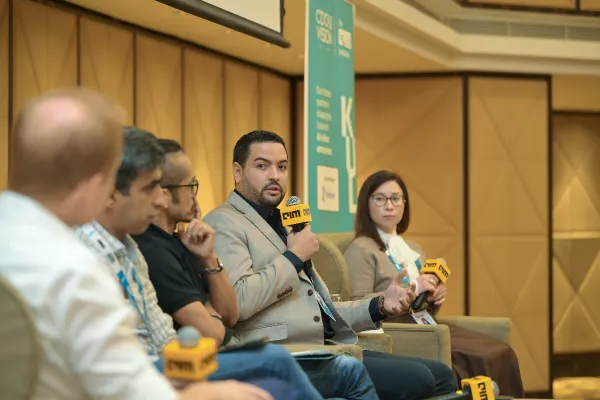
The last session of the day is usually the hardest one to hold a room's attention. At The CIO Room Jakarta, the closing panel on agentic AI and the future of enterprise growth did it by dropping the formality and getting straight to what was actually working.
Moderator Erwin Susilo, Head of Digital Transformation at PT. Sinar Mitra Sepadan Finance (SMSFinance), set up a deliberate contrast. On one side were conventional, heavily regulated institutions: a bank, a multifinance company and an insurer, several still moving off on-premise infrastructure. On the other were digital natives "born with cloud," already shipping AI agents to customers. The question running through the hour was simple: what can each side learn from the other?
From one agent to a team of agents
Erwin opened by asking what separates agentic AI from the "old school" agent-based systems that have handled customer service for years.
Partner with The CIO Room
Reach the leaders this piece is about
Four or five partners per room, alongside 50–100 CIOs and enterprise AI leaders. Tell us who you want to meet.
Kukuh T Wicaksono, Head of IT Digital Transformation at Hanwha Life Indonesia, offered a clean framing. An AI agent is like a single person: it can search data, analyse it, run a business calculation, call an API and reason through a task. Agentic AI is a team, an orchestration of multiple agents that coordinate, work step by step or in parallel. That makes it more powerful, he said, but also much harder to get right. Governance, coordination between agents and reducing hallucination all have to be designed in from the start.
Yonatan Kristiono Gunadi, Head of Product and Technology at FIT HUB, explained the progression through the gym chain's own journey:
- Machine learning to score leads and predict which prospects were most likely to convert.
- Generative AI to create personalised training programmes for new members from their body composition tests, with week-by-week plans. Still in beta, it could grow into something closer to an AI personal trainer as workout and lift-progression data builds up.
- Agentic AI for organic lead farming: agents scan social media for people comparing gyms or showing intent, then route them to FIT HUB's website and app. Customer service had never had the capacity to follow those conversations manually.
The two turned out to be complements
- Substitutes
Customer experience: start where mistakes are cheap
Erwin pushed on a concern raised in an earlier session that generative AI in customer service is still largely a sandbox, and that bots often fail to resolve real problems.
Kunal Kaira, Head of Data at Flip, argued that customer experience can never be fully handed to an agentic system. His philosophy: don't start by asking where you can save cost, start where a mistake is least expensive. Let agents handle those cases, keep humans on the sensitive ones, and make sure humans are overseeing the process either way.
Regulated players: governance first, then use cases
For the banks and finance companies, the story was about sequencing.
Frenny Na, Head of Data Intelligence and Strategic Analytics at Permata Bank, said the bank deliberately did not start with use cases. In a regulated industry, it first built AI governance and made sure everyone from top management to frontline staff shared the same values around it. Only then did it launch its first agentic pilot: a knowledge search assistant for the contact centre. Agents answering calls no longer have to open several applications to check campaigns, offers or customer data, which improves SLAs. The same approach is being extended to internal questions from staff about leave and bank policies.
Getting from proof of concept to production takes time. It needs regulatory approval from OJK, and the bank, only now moving to the cloud, has to make a clear ROI case for the investment in a way digital natives often don't.
Toni Hutomo Putro, Head of Data Governance at Adira Finance, described the moment with a memorable image: before scaling agentic AI, "we need to tame the wild horse." That means guardrails, monitoring and people watching what the AI does. The underlying shift isn't entirely new, he noted, since "data is the new oil" was the conversation only a few years ago. But the complexity of today's tools brings real risk: what data is being used, whether it complies with regulation, and making sure the company isn't misusing data it is responsible for governing.
Where agents are already earning their keep
01Kukuh shared two production use cases at hanwha life indonesia:
- Underwriting. Reviewing an applicant's documents, claims history and medical declarations used to take an underwriter one to two days. AI agents now do the searching and analysis and produce a recommendation. The human underwriter still makes, and is accountable for, the final decision.
- The software development lifecycle. Agents support the full chain, from user requirements to business requirement documents, product requirements, programming specifications and database design, then on to generating code, simulating business scenarios and fixing errors. The result, Kukuh said, is a team of five or six people working with the capability of 50 or 60. Because the process is documentation-first, code generation stays grounded in specifications rather than hallucinating.
At Flip, Kunal described agents spread across the organisation. Internally they handle analysis, heal and build data pipelines, ship product features by pushing merge requests directly to the codebase, and support talent teams. Externally they power customer service and lead generation.
How do you keep agents under control?
Erwin raised the risk of what he called a paradox: make something easy enough to use, and people will use it, exploit it and run up costs. He pointed to reports of a fast-food chain opening AI to customers and getting a runaway bill.
Kunal's answer was centralisation. Just as data governance works best when practices are standardised centrally, agentic systems need an "agentic control panel": a single layer for authentication, routing and role-based access. At the other end sits a guardrail proxy. AI doesn't take consequential actions directly. Deterministic systems or classifiers decide whether an action can proceed (an agent told to delete a database should know it can't), with humans in the loop depending on how sensitive the case is.
On measuring success, he warned against technical metrics alone. A customer chatbot shouldn't be judged on deflection rate but on customer experience scores, against a baseline, ideally with A/B tests that compare a treatment group to a control.
Yonatan described simpler, practical controls at FIT HUB: caps on how often members can generate a new programme, keeping social media lead farming to a limited set of cases, and a tight feedback loop with the CX team so agents spend tokens only on the highest-intent conversations.
Customers are getting less patient
Agentic AI is also reshaping what customers expect. Yonatan noted that people who once demanded "a real person" will increasingly accept an agent if it is fast and gets the job done. Speed becomes addictive, and the bar keeps rising. The same is happening with personalisation: generic segmentation will feel outdated as customers come to expect experiences tailored specifically to them.
Kunal added the flip side. Patience is shrinking, and customers abandon faster when they know they're talking to an agent that can't help. Getting that balance right, he said, will be the key to experience going forward.
Vertical knowledge is the real moat
Asked for a playbook, Kukuh said the horizontal layer is largely the same everywhere: similar technology, platforms, frameworks and SOPs. Technology isn't the bottleneck. What differs is vertical knowledge, the business context specific to each industry and company. Building that properly, and drawing knowledge from each division, is where success is decided.
Who is accountable when an agent gets it wrong?
The panel agreed accountability has to be designed
- Assumed
- Kukuh called it shared accountability. Technical teams own technical errors, and business teams own whether the agent fits the business process.
- Frenny explained that Permata Bank applies a responsible AI framework across the three lines of defence. The first line must make everything checkable, the second line reviews audit logs through dedicated dashboards, and the third line carries accountability too.
- Toni described how Adira's data governance council, set up about five years ago with legal, compliance, risk and other directorates, is evolving for AI. The company is defining who is accountable for building models, for the business outcome and for the data, so that if an engine misbehaves it is clear which layer must respond.
- Kunal was blunt: "You can never blame the systems." Audit trails are a reactive approach. The proactive one is deciding up front what level of escalation you are comfortable with, and letting that decide which use cases you deploy.
What changes by 2030?
Erwin suggested organisational structures will change as individuals manage their own fleets of AI agents. The panel's predictions:
- Frenny Na: Banks will leapfrog as regulators become more open. Operations will shift heavily to agentic AI and headcount will fall in some areas, but AI won't simply replace people. Staff will need to upskill, starting with prompting well.
- Yonatan Kristiono Gunadi: Companies will be able to do far more than they ever thought possible. The new challenge is making sure they are solving the right problems, at a much faster pace.
- Kukuh T Wicaksono: Almost anyone, including product managers, will be able to build applications with vibe coding. That will increase demand for software engineers who understand the fundamentals and can review and direct agentic tools to make software safer and more powerful.
- Toni Hutomo Putro: Governance will gain agentic systems that detect vulnerabilities across data and processes, and even prescribe actions. People will move from programming AI to monitoring it.
- Kunal Kaira: World models that predict life events and market behaviour will let companies anticipate consumer needs and ship features before demand appears, future-proofing products in advance.
The takeaway
Erwin closed by noting that AI will transform both companies' internal operations and the customer experience. For regulated finance, the near-term work is finding balance: settling governance and compliance, proving cost efficiency and managing token spend. The digital natives showed what is possible. The regulated players showed what it takes to do it safely. Both agreed the journey has started and is only going to become more meaningful.
Join the conversation at The CIO Room
Conversations like this happen behind closed doors at The CIO Room, an invite-only boardroom series bringing together senior CIOs, CDOs and data and AI leaders across 20+ cities worldwide.
- Technology leaders: Request an invitation to an upcoming edition and trade notes with peers solving the same problems. See the full event calendar
- Solution providers: Put your brand in front of the enterprise decision-makers shaping AI budgets. Explore sponsorship opportunities
CIO summit Jakarta · Compare this with our AI conference for CIOs.