

Contents
As AI adoption shifts from experimentation to enterprise-scale implementation, understanding what success looks like across industries becomes increasingly critical. This panel at CDO Vision Singapore 2026, the fifth stop of the CDO Vision AI World Series, explores how organizations are using AI to drive operational efficiency, enable smarter decision-making, and deliver personalized experiences at scale.
The discussion examines how leaders are aligning AI initiatives with core business objectives, while also navigating challenges around ethics, governance, and workforce adaptation. Panelists dive into what it takes to translate AI-driven insights into actionable strategies that meaningfully impact business performance, moving beyond experimentation toward sustained, real-world value.

Madhukar Makhija
Global Head of Data and Analytics, Securities Services, HSBC
Wee Ming Koh
Head, Enterprise Analytics, AIA Singapore
Fan Yang
VP, Head of Analytics CoE, Income Insurance Limited
Vishnu Nanduri
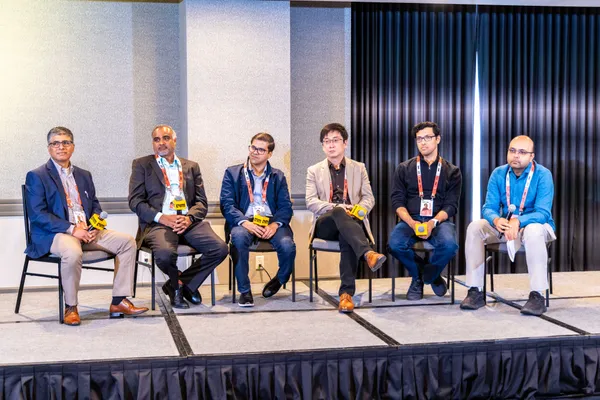
Head of AI & Innovation (ASEAN & S. Korea), KyndrylThe panel featured Padmanabh Padiyar, Head of Transformation at OCBC's Group Data Office; Madhukar Makhija, Global Head of Data and Analytics for Securities Services at HSBC; Wee Ming Koh, Head of Enterprise Analytics at AIA Singapore; and Fan Yang, VP and Head of Analytics CoE at Income Insurance. The discussion was moderated by Vishnu Nanduri, Head of AI & Innovation (ASEAN & S. Korea) at Kyndryl. The conversation covered four areas: data foundations, scaling AI use cases, agentic AI in practice, and workforce transformation. Instead of exploring what AI could do in theory, the conversation centered on the practical hurdles, decisions, and organizational dynamics involved in deploying it at scale.
01Organizational readiness
The panel's clearest consensus was, the gap between a successful proof of concept and a production deployment is not primarily technical. As Padmanabh put it, the distance between a pilot and productionization is "probably a 100-mile journey" one that requires examining process readiness, operating models, risk management, compliance implications, and unit economics, all before a use case earns the right to scale.
Partner with CIO Vision
Reach the leaders this piece is about
Four or five partners per room, alongside 50–100 CIOs and enterprise AI leaders. Tell us who you want to meet.
Several panelists noted that business units often bring AI requests to their data teams without having thought through these dimensions. A PoC might produce excellent results in a narrow context, but if it addresses only 2% of actual volumes, or solves only part of a problem rather than transforming an entire workflow, the business incentive to adopt it evaporates. Padmanabh raised a pointed question that often goes unasked: does this actually require AI, or would a rule-based or RPA solution serve just as well?
Fan added that for use cases with clear success criteria, particularly traditional machine learning models, teams have found it easier to establish clear ownership and approval paths. The more challenging cases are those involving generative AI, where questions of ownership, operating model design, and risk tolerance remain less settled.
The underlying point: many AI initiatives don't stall because the model failed. They stall because the organization wasn't prepared to operationalize what the model produced.
02Data foundations
On the question of data readiness, the panel reached a clear position: waiting for complete, perfect data before beginning AI work is neither practical nor necessary. Padmanabh was direct "you're never going to have enough data" and argued that the more useful goal is identifying the core data foundation that can accelerate 70–80% of priority use cases, then building additional pipelines as specific needs emerge.
Wee Ming described a more deliberate, purpose-driven approach. For a leading regional insurer handling sensitive health data, data collection is never passive, it requires clear intent and often incentives. The process begins with internal questions: what problem are we actually trying to answer, and is this data genuinely addressing it? External data acquisition only follows once that internal clarity exists.
A major insurance firm, running for four to five years, was still actively seeking new external data partnerships, with banks and retailers
- To rebuild the model, but because new data sources were expected to improve performance more than model refinement alone would
Madhukar added an architectural dimension: the value of a modern, cloud-native data infrastructure isn't just storage, it's the ability to ingest data from disparate sources and distribute it across channels dynamically. At a global bank operating across dozens of markets and source systems, making data ingestion and distribution seamless is, in his view, the precondition for putting AI to work reliably on top of it.
03Agentic AI
The panel's most nuanced discussion centered on agentic AI. Madhukar opened by drawing a distinction that he argued the industry still hasn't fully resolved: the difference between true agentic AI, where AI acts autonomously on behalf of humans across perception, planning, action, control, and learning, and what most organizations are actually building, which is orchestrated workflows where humans remain in the loop, particularly at the control stage.
In practice, at a leading global bank, the focus has been on exception management and client onboarding, areas that are operationally heavy but where the risk of full automation is more contained. Straight-through processing for client servicing is an aspirational direction, but in areas involving financial transactions or regulatory exposure, the approach remains conservative.
Fan echoed that caution explicitly in the context of health claims processing at a regional insurer, which involves document validation, coverage verification, and claims decisions. This is precisely the kind of high-stakes domain where agentic automation carries reputational and regulatory risk. The concern was stated plainly: no organization wants to appear in the news for using AI to decline claims. At the same time, agentic coding tools have seen wider internal adoption, because the output is verifiable and the feedback loop is tight.
Wee Ming raised a different concern, the difficulty of identifying use cases where autonomous agents solve a genuinely deep problem rather than simply automating a surface-level exchange. The example given: if both parties in an email conversation use autonomous agents to respond, the communication is automated but the underlying issue remains unaddressed. Unlike autonomous vehicles, where the logistical problem is well-defined, many candidate use cases for agentic AI in enterprise settings don't yet have that clarity.
Padmanabh offered a contrasting data point. A "source of wealth" solution at a leading regional bank, an agentic AI application for customer onboarding, was described as one of the first of its kind in the market and has delivered measurable acceleration. The same institution has also mapped a multi-step advisory workflow covering prospect identification, meeting preparation, and portfolio rebalancing, building five connected use cases rather than one isolated tool. The more ambitious direction being explored is agentic workflows for balance sheet optimization in corporate treasury, where Padmanabh noted that a single basis point of improvement can represent approximately millions in P&L impact.
The tension across the panel was visible: agentic AI is producing results in bounded, internal, or well-defined contexts. For high-stakes, externally-facing, or regulatory-sensitive applications, the industry is still developing the frameworks to operate responsibly at that level.
04Workforce transformation
On the workforce question, the panel's answer was consistent: AI is not generating a wave of entirely new roles. Prompt engineer and AI orchestrator, despite industry expectations, have not materialized as distinct positions in any of the organizations represented.
What is changing is the baseline expectation attached to existing roles. Padmanabh described this shift explicitly, at a leading bank, every hire, from relationship managers to product owners to those in transformation functions, is now evaluated on whether they can think and operate in an AI-native way. The standard is not deep technical expertise; it is the practical capability to use AI tools effectively within one's domain, in the same way spreadsheets or presentation software became embedded in professional work.
Wee Ming flagged a risk on the other side. As large language models make it easier for non-technical employees to build applications, the volume of use cases being generated across the organization has increased, but the rigor applied to evaluation and validation has not kept pace. The analytics CoE at a major regional insurer finds itself working more closely with AI engineers to ensure that statistical standards and regulatory requirements are upheld as development becomes more distributed.
Madhukar noted the emergence of a Group Chief AI Officer role at a leading global bank, a second-line governance function, analogous to the Chief Data Officer, responsible for standardizing AI policy, risk frameworks, and deployment architecture across the institution. That governance layer is new. The practitioners building models and pipelines largely remain within existing functions, with AI capabilities becoming embedded into their existing roles and responsibilities rather than carved out into separate teams.
AI technology is largely available across banking and insurance.
- Building evolving data infrastructure.
- Establishing proactive governance.
- Identifying transformative use cases.
- Preparing workforce for AI integration.
CIO summit Singapore · Compare this with our AI conference for CIOs.