Contents
At The CIO Room, the Chief Knowledge Officer of Japan's Innovation Platform Agency argued that the winners of the AI era will not be those with the smartest models, but those who engineer their knowledge, data and systems best.
Most conversations about enterprise AI still begin with the model: which one to license, how capable it is, and what it costs per seat. Kenji Hiramoto wants leaders to start somewhere else entirely.

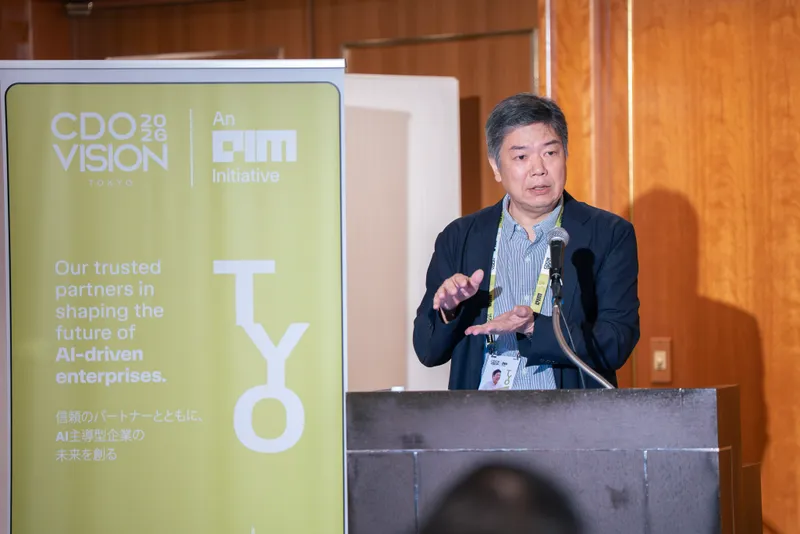
"AI is not a special issue," he told the audience. "AI is common technology." Any organization can subscribe to the same frontier systems as its competitors. What cannot be bought off the shelf, he argued, is an organization's own data, its accumulated knowledge and its culture. That is where differentiation now lives, and that is where leaders should be putting their attention and their money.
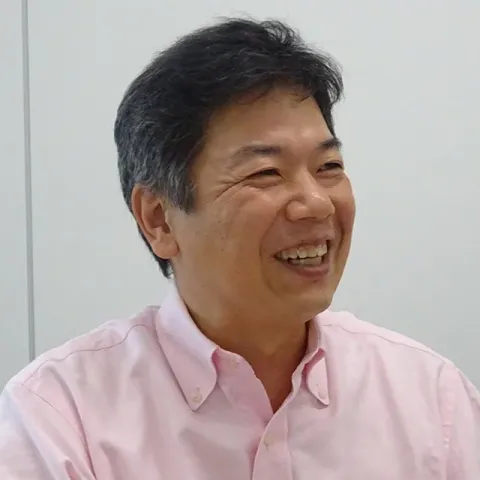
Hiramoto brings an unusual vantage point to the question. He began his career at NTT Data, spending a decade in the private sector before moving into government, where he served at the Ministry of Economy, Trade and Industry, the Cabinet Secretariat and Japan's Digital Agency. Three years ago he joined what is now the Innovation Platform Agency (IPA), which changed its name just two months before his talk. He is also Deputy Executive Director of Japan's AI Safety Institute (AISI), a cross-government effort involving 12 ministries and five government-related organizations, holds a position at the University of Tokyo, and was this month named the IPA's Chief Knowledge Officer.
Partner with The CIO Room
Reach the leaders this piece is about
Four or five partners per room, alongside 50–100 CIOs and enterprise AI leaders. Tell us who you want to meet.
The old playbook is too slow
Hiramoto's first target was the conventional way enterprises approach new technology: write a business case, run a pilot, calculate the ROI, then scale. That sequence made sense when technology moved slowly. Today, he said, society and technology are changing so fast that the traditional model has become a liability.
His prescription was to change the organization rather than fixate on the tool. Leaders should focus on three things that are genuinely their own: data, because it is original to each organization; culture, because every organization carries good habits, information and knowledge that can be put to work; and speed, because the pace of change leaves no room to wait.
Agentic AI changes the stage
The shift that makes this urgent, in Hiramoto's view, is the move from standalone AI to agentic AI. Until recently, enterprises treated frontier AI as a discrete system: a chat interface, or a tool for a specific task. Agents are different. They are, as he put it, a "system of systems." AI already sits in cars, in cities and in homes, and agents connect those systems and act autonomously across them.
That autonomy means organizations must be able to monitor what agents are doing. And it exposes a blind spot Hiramoto sees among many Japanese policymakers and technology executives, who remain focused on frontier model capability. The smartest models still matter, he acknowledged, but the more important conversation is about how agentic systems are architected, connected and governed.
A new competitive advantage: engineering disciplines
An engineer by training, Hiramoto argued that the AI era calls for a return to engineering rigor in management itself. He highlighted two disciplines in particular.
The first is knowledge engineering, which he described as the pipeline from data to AI: how data is used, and above all how its meaning is understood. He noted that the traditional Chief Knowledge Officer role was about knowledge management. The new version of the role is about knowledge engineering.
The second is requirements engineering. An organization may hold vast amounts of knowledge, but no one can absorb it all. Clear requirements are what make that knowledge usable, letting both people and AI understand processes, data structures and what is actually being asked.
Combine these with systems engineering, he said, and leaders gain something powerful: the ability to simulate the business, test changes before committing, and make continuous enterprise evolution far easier.
Rethinking ROI
Given the room's focus on investment, Hiramoto spent a significant part of his talk on return on investment, and his message was a provocative one. Treating AI as a tool to be bought and measured made sense when it was a component. Now, he argued, AI is a strategic foundation, closer to electricity, water or roads. Infrastructure is not judged on simple ROI.
Instead, he proposed a pyramid of measurement. At the base, organizations should measure AI readiness, drawing on existing readiness indices. Next comes capability. ROI sits at the top. It still matters, but it is the hardest to pin down because the link between foundational AI investment and outcomes such as sales is complicated and indirect. Alternative indicators such as data readiness and knowledge coverage should be tracked well before that.
He also urged leaders to look past the visible line item of AI subscriptions to the hidden costs that quietly erode value:
- Data debt: without structured, clean data, staff waste time and AI underperforms.
- Technology debt: systems that are not interoperable make it hard to adopt the latest models and emerging technologies.
- Governance debt: weak data governance compounds every other problem.
- Talent drain: if an organization cannot use current AI tools, its best people will leave for companies that can.
- Evolution debt: the cost of failing to keep pace as the technology moves on.
From one-time certification to continuous verification
Because agentic AI is not an independent system, Hiramoto said it demands systems engineering across architecture, interfaces, requirements, knowledge and governance, with one element he singled out as especially important: continuous verification.
The old model of certifying a product once no longer holds when its software updates constantly. Japan is working with other countries through the international AI standards committee ISO/IEC JTC 1/SC 42 to develop conformity testing for continuous verification, and Hiramoto expects standards to emerge within roughly the next two years.
The new role of the data leader
Hiramoto closed with a direct message to the CDOs and CIOs in the room. Building AI capability, he said, rests on a set of foundations: knowledge, requirements and systems; trusted data, meaning authoritative sources and a single source of truth, since correct answers depend on correct data; sound architecture; governance fit for a constantly updating society; and continuous learning.
That last point carried particular weight. People who use AI daily and discuss problems with it gain new ideas and knowledge. Organizations must capture that knowledge, gather it back in, and keep reconstructing what they know, both for individuals and for the institution as a whole.
So where should the money go? Not primarily into models or applications, which Hiramoto regards as common technology available to everyone. The real capital of an organization, he argued, is its enterprise knowledge, its requirements and its systems. AI is a tool and a partner, but its value is maximized only when knowledge and data are in order.
That, he concluded, makes the data leader one of the most important people in the enterprise. For an audience of exactly those leaders, it was both a validation and a challenge: the next phase of AI will be won not by whoever adopts fastest, but by whoever engineers their organization to make the most of what only they possess.
CIO summit Tokyo · Compare this with our AI conference for CIOs.