Contents
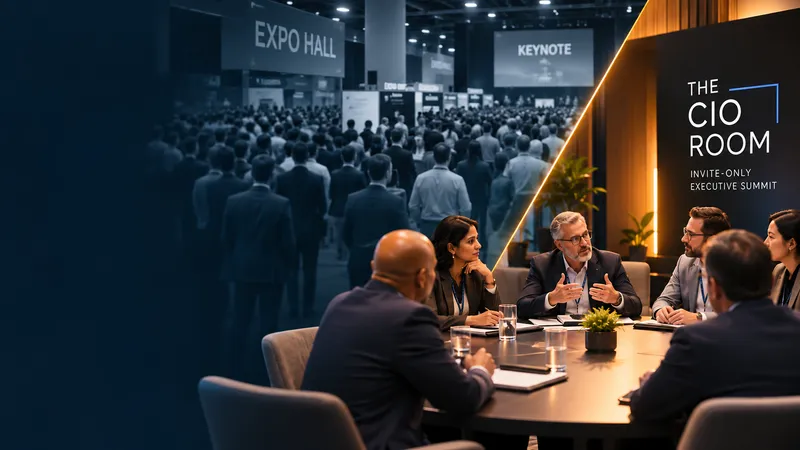
The expo hall had its era. In 2027, the most senior technology leaders are choosing smaller, invite-only rooms where every seat is a peer and every conversation is worth the day.
Every CIO knows the routine. Fly in, collect the lanyard, sit through a keynote that could have been a press release, then walk the expo floor while forty vendors scan your badge. By the end of day two you have a bag of swag, a phone full of follow-up requests, and very little you can take back to your leadership team on Monday.
For a long time, that was simply the price of staying current. It isn't anymore. Across the industry, senior technology leaders are quietly cutting the mega-conferences from their calendars. They aren't giving up on events. They're getting far more selective about which rooms deserve a day of their time.
This piece looks at why that shift is happening, what the data says, and what the best executive tech events of 2027 look like instead.
Partner with The CIO Room
Reach the leaders this piece is about
Four or five partners per room, alongside 50–100 CIOs and enterprise AI leaders. Tell us who you want to meet.
The big-conference bargain has broken
Large technology conferences were built on a simple trade: you give up three or four days, and in return you get access to everything in one place. Products, analysts, peers, ideas. That trade made sense when information was scarce. Today it is the opposite. A CIO can get a product demo on demand, read the analyst note the day it lands, and watch the keynote on replay at 1.5x speed. What's scarce now is a candid conversation with someone who has the same problem and has already tried to solve it.
Big conferences struggle to deliver that, for four structural reasons.
1. The expo hall is built for vendors, not buyers
The economics of a large conference run through the exhibit floor. Booth sales pay for the venue, so the show is designed to push attendees past as many booths as possible. For a CIO, that means the most valuable hours of the day are spent dodging conversations rather than having them. The more vendors in the room, the less any single conversation is worth.
2. Every conversation becomes a pitch
When the ratio of sellers to buyers tips too far, executives switch into defensive mode. They stop asking real questions because every question invites a follow-up sequence. Gartner's 2026 sales research found that 67% of B2B buyers now prefer a rep-free buying experience, and an earlier Gartner survey found that 73% actively avoid suppliers who send irrelevant outreach. A badge scan at a crowded booth is often where that irrelevant outreach begins.
3. Keynotes are generic by design
A main-stage session written for 10,000 people has to work for the CIO of a global bank and a first-time IT manager at the same time. So it stays at altitude: big trends, big promises, very little about governance models, budget fights, or the AI pilot that stalled at legal review. Senior leaders already know the headline. What they want is the messy middle, and that only gets discussed in rooms where people trust each other.
4. The time math no longer works
A multi-day conference is often a full working week once travel is counted. For a CIO carrying an AI agenda, a modernisation programme, and a board that wants results this quarter, that is an expensive week. Leaders now ask a simple question before they register: will I come back with something I can act on? For most large events, the honest answer is "maybe".
What the data says about executive tech events
This isn't just anecdote. Event organisers and B2B marketers are seeing the same pattern from the other side.
- Fewer, smaller events. Forrester's Q1 2026 State of B2B Events survey of more than 400 event decision-makers found that nearly 70% of organisations are running fewer events. A majority plan more intimate networking events and in-person events under 200 attendees, while only 18% plan more large hosted events.
- More participation, less broadcast. In the same Forrester survey, two-thirds of organisations plan more workshops, roundtables and structured networking.
- Small is already the norm. Event platform Lyyti's 2026 trends data shows that 84% of the events it analysed had fewer than 50 participants.
- ROI is under scrutiny. A 2026 Skift survey of more than 1,000 travel-industry executives found that only 36% said their most recent conference clearly delivered ROI.
The conclusion is consistent across sources: the industry is moving from reach to relevance. The question is no longer "how many people came?" but "were the right people in the room, and did anything happen because of it?"
Where CIOs are going instead: the invite-only boardroom
Curated, not open
Attendance is by invitation or application with vetted senior peers.
Small enough to talk
50 to 100 leaders, enabling real conversations and roundtables.
Buyer-heavy
Few carefully chosen partners participate inside the discussion.
Working sessions, not just talks
Focus on real decisions and peer learning.
One day, close to home
Single-day events in local regions to protect leaders' time.
- Curated, not open. Attendance is by invitation or application. Every guest is vetted for seniority and relevance, so the person next to you is a peer, not a prospect list.
- Small enough to talk. Fifty to a hundred leaders, not five thousand. Small enough that the panel becomes a conversation and the roundtable actually goes round the table.
- Buyer-heavy. A handful of carefully chosen partners rather than an exhibit hall. Vendors take part in the discussion instead of standing behind a booth.
- Working sessions, not just talks. Leaders compare notes on real decisions: what to fund, what to kill, how to govern AI at scale, how to explain the numbers to the board.
- One day, close to home. A single focused day in your own city or region, instead of a week away.
That combination does something big conferences can't. It turns a calendar entry into a room where peers speak openly, because nobody is there to be sold to.
Inside The CIO Room
The CIO Room is an invite-only series of CIO and enterprise AI leadership summits run by AIM Media House, formerly known as the CIO Vision and CDO Vision series. It was built around exactly the problems described above.
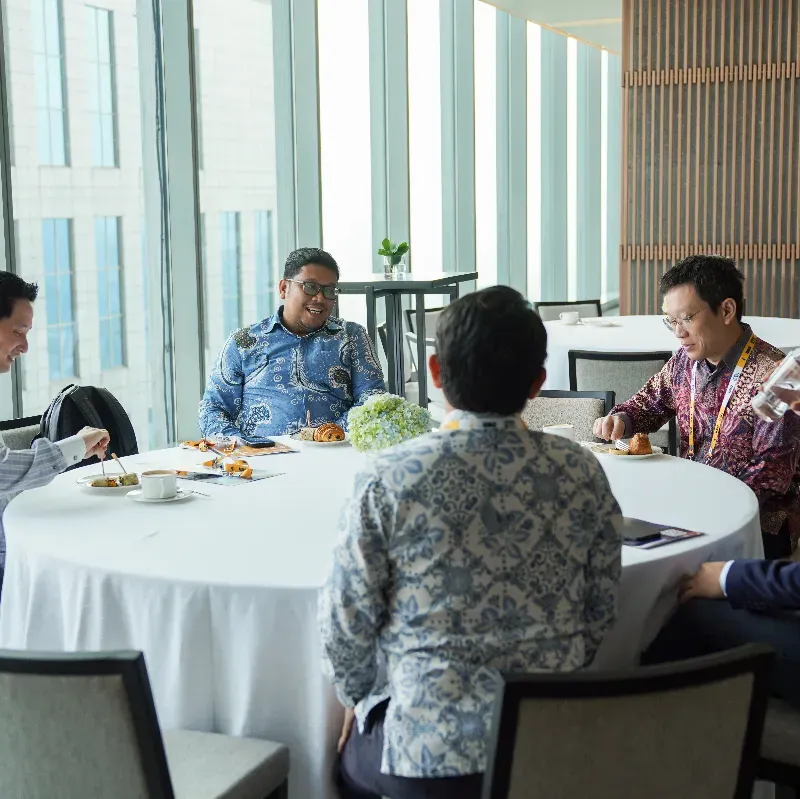
Each room is a single day with 50 to 100 invited CIOs and enterprise AI leaders. There is no expo floor and no breakout halls. Only four or five partners take part, and they sit inside the conversation rather than outside it. The agenda is designed for participation:
- Two Vision Talks from leaders who have shipped something worth learning from
- Four panels on the decisions CIOs are making right now
- An open roundtable where every voice in the room is heard
- A working session on the next 18 months of AI bets
- The Vision AI Awards, recognising enterprise AI work that delivered
The audience is what makes the format work. Across the series, 78% of attendees hold budget authority for AI, data or technology, 73% are heads, VPs or C-suite, and 62% come from organisations with more than 5,000 employees. Banking, financial services and insurance make up the largest share of the room, followed by healthcare and life sciences, retail and CPG, and manufacturing.
You can get a feel for the conversations on the Inside the Room page, and see which leaders have already taken part on the speakers page.
How to choose CIO conferences in 2027: six questions to ask
Whether or not you attend The CIO Room, these questions will help you decide which executive tech events earn a place on your 2027 calendar.
- Who else will be in the room? Ask for the audience profile by title, company size and industry. If the organiser can't tell you, the room isn't curated.
- What's the buyer-to-vendor ratio? If sellers outnumber or rival buyers, expect a pitch-heavy day.
- Is there an expo floor? If the event's business model depends on booth sales, your time will be designed around them.
- How much of the agenda is participatory? Look for roundtables and working sessions, not just stage time.
- Can I get there and back in a day? Regional, single-day formats protect your week.
- What will I bring back on Monday? If you can't name a likely takeaway before you go, skip it.
For a wider comparison, see our guide to AI conferences for CIOs and the CIO AI Priorities 2027 study.
What this means for technology vendors
The shift away from big conferences is a problem for vendors who measure success in badge scans. It is an opportunity for vendors who measure it in pipeline.
When buyers avoid crowded expo halls and ignore cold outreach, the most efficient way to reach them is to be invited into the conversations they actually value. That is the logic behind The CIO Room's partner model. Partners take one of only four or five slots per room, alongside 50 to 100 senior leaders, so they aren't competing with dozens of other booths for attention.
The results reflect that focus. Partners report 60+ tracked one-to-one meetings, an 80% buyer-to-vendor ratio across the room, and 40% of partners report deals within 30 days.
If your 2027 plan still leans on large trade shows, it is worth asking how many of those badge scans became real conversations, and how many of those conversations became revenue. Explore partnership options or request the 2027 partner prospectus.
The CIO Room 2027 calendar
The CIO Room runs as a global circuit across more than 20 cities on four continents. 2027 rooms include Los Angeles, Kuala Lumpur, Dallas–Fort Worth, Hong Kong, Chicago, London, Atlanta, Seattle and Dubai, with more cities to be announced. Seats in each room are limited.
01See all 2027 rooms and request your seat
Frequently asked questions
What are the best CIO conferences in 2027?
The right event depends on your goals. Large vendor conferences are useful for product roadmaps and broad market updates. For peer learning, candid discussion and decisions on AI strategy, many CIOs now prioritise small, invite-only executive events such as The CIO Room, where the audience is curated and the agenda is built around participation.
Are invite-only executive tech events worth the time?
For senior leaders, usually yes, because the value comes from who is in the room. A single day with 50 to 100 vetted peers often produces more usable insight than several days at a large conference.
How do I get invited to The CIO Room?
Senior technology, data and AI leaders can request an invitation from any event page on thecioroom.com/events. Each request is reviewed to keep the room at the right level of seniority. Invited leaders attend as guests.
How can my company partner with The CIO Room?
Each room has only four or five partner slots. Visit the sponsors page to see the audience profile and request the 2027 partner prospectus.
Your next room
The big conference isn't dead. It still has a role in launches, product education and broad market reach. But it is no longer where the most senior technology leaders do their thinking. That work has moved into smaller rooms, with fewer people, better questions and no booths.
If you lead technology, data or AI at a large enterprise, request your invitation to a 2027 CIO Room. If you want to be in the conversation with those leaders, talk to us about partnering.
Sources
- Forrester, The Next Era Of B2B Events: Eight Data-Backed Shifts Defining 2026 (Q1 2026 State Of B2B Events Survey)
- Gartner press release, Gartner Sales Survey Finds 67% of B2B Buyers Prefer a Rep-Free Experience (March 9, 2026)
- Gartner press release, Gartner Sales Survey Finds 61% of B2B Buyers Prefer a Rep-Free Buying Experience (June 25, 2025)
- Lyyti, Small events, big impact: why smaller events are winning in 2026
- Skift, What 1,000+ Travel Executives Really Think About Conferences (May 2026), via Hospitality Today
- The CIO Room audience and partner data, thecioroom.com
CIO summit Los Angeles · CIO summit Hong Kong · CIO summit Kuala Lumpur · Compare this with our AI conference for CIOs.