Contents
Four Malaysian technology leaders agree that AI's return is real — but only for organisations willing to measure the right things, control the costs, and do the hard work of getting people to use what they build.
Every boardroom now asks the same question of its technology chiefs: where is the return on all this AI spend? On a panel titled "When Does AI Investment Pay Off?", four senior executives from Malaysia's entertainment, telecoms, capital markets and investment sectors offered an unusually candid answer. The return arrives, they argued, but rarely on the timeline or in the form that pilot decks promise.

Serena See
Chief Information Officer, TGV Cinemas
Ija Mohan
Head of Digital Transformation, redONE Mobile MY
Dr. Sadesh Manikam
Executive Vice President (EVP), Enterprise Data Office and Data Protection Officer, Bursa Malaysia
Budiman Bujang
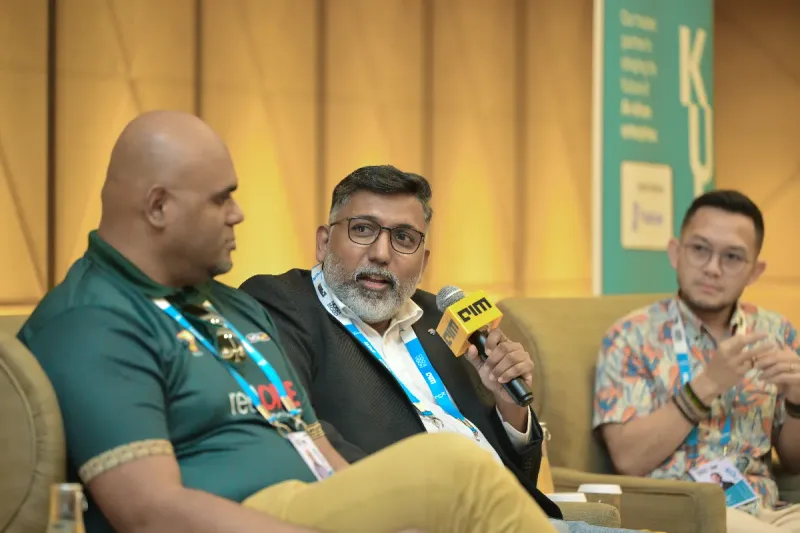
Deputy Chief Digital Officer, Johor CorporationThe panel was led by Serena See, Chief Information Officer of TGV Cinemas, and featured Ija Mohan, Head of Digital Transformation at redONE Mobile; Dr. Sadesh Manikam, EVP of the Enterprise Data Office and Data Protection Officer at Bursa Malaysia; and Budiman Bujang, Deputy Chief Digital Officer at Johor Corporation (JCorp). What emerged was less a celebration of AI than a sober guide to making it earn its keep.
Payoff means different things to different businesses
See opened by challenging the idea of a single definition of AI return. At TGV Cinemas, which she describes as straddling entertainment and retail, AI already touches customer experience, revenue generation and internal productivity, with further projects still in R&D. Each company, she said, must decide its own spectrum of value: higher revenue, better productivity, or reduced risk and stronger compliance. The common anchor should be long-term competitive advantage.
Partner with The CIO Room
Reach the leaders this piece is about
Four or five partners per room, alongside 50–100 CIOs and enterprise AI leaders. Tell us who you want to meet.
For Ija Mohan, the definition is starkly concrete. redONE is a mobile virtual network operator with about a million postpaid customers across Malaysia and roughly half a billion in annual revenue. Its owners sit on the board, so ROI translates directly into dividends. His answer to them never changes: no investment in AI, data platforms or data transformation will show a return unless the organisation actually adopts it. He jokes that his job is less about technology than about lobbying colleagues to change — organisational transformation rather than digital transformation.
Bursa Malaysia, according to Dr. Sadesh Manikam, is now moving from proofs of concept into a scaling and governance phase. Several pilots have reached production, and the exchange is looking at AI to improve customer experience, support regulatory work, and grow non-trading revenue through new data products.
Budiman Bujang brought the investment-holding lens. He once asked JCorp's management a provocative question: if nobody at the holding company came to the office, would dividends from its investee companies and revenue from land sales still flow? His point was that value at JCorp is created through the portfolio, so technology has to be judged by how it elevates the business. His first move was an enterprise architecture blueprint linking business capabilities to the technology stack. AI, he said, now serves as JCorp's intelligence layer — and the goal is not to digitise old processes, which merely inherits their problems, but to reimagine them.
The hidden cost of intelligence
If value is the easy half of the business case, cost is the hard half. See pointed to generative AI chatbots as a cautionary example. Teams start out wanting a bot that talks like a human, delights customers and even sells. Then the token bills arrive. Leaders must draw a line, she argued, between how intelligent a system needs to be and what the business can sustainably pay for.
Mohan took the cost question somewhere unexpected. redONE has demoed an outbound AI voice bot so convincing that he could not tell it was a machine, even when he knew. Yet he questions how durable that investment is. Customer service, he noted, only ever meets unhappy customers, and contacting support is the task customers hate most. Once consumers use their own AI assistants to deal with service lines, companies will find their carefully tuned chatbots talking to other bots. He half-jokingly suggested firms may soon need an interface for AI-to-AI conversation rather than one built for humans. Today's investment solves today's problem, but its ROI may look very different within six to twelve months.
Those are small wins
- True measures
No adoption, no payoff
On one point the panel was unanimous: an AI system that nobody uses returns nothing. How to get people to use it — and keep using it — drew four distinct answers.
Start from the user's pain
- The technology
Fix the data and the governance first. Dr. Sadesh Manikam said adoption collapses when data is unclean or untrusted: confidence goes, AI products don't sell, and the journey stalls. Bursa has built an enterprise data platform with data governance at its core — deciding what information goes to whom, and complying with regulations such as Malaysia's Personal Data Protection Act and securities rules. Making data AI-ready also means taking AI ethics seriously now, since staff are already uploading data to generative AI tools without proper classification.
Without data minimisation and controls, data can be misused and poor decisions can hit revenue and the P&L directly. He also urged leaders to match products to organisational maturity: build a super-app before the organisation is ready, and adoption will be low. Data and AI literacy programmes, internal and external, close that gap.
Win the leadership, then the culture. See stressed that adoption is ultimately human. She credits a supportive CEO, but said IT leaders must also sell their ideas to fellow C-suite members and department heads so the message cascades from the top. AI adoption, she said, is as much culture and change management as it is technology.
Beware adoption that breeds bad habits. Mohan offered the panel's sharpest warning. At a management offsite, redONE's CEO presented a single NotebookLM infographic to show that anyone could use AI. Over the next three days, every department head converted their deck into one — information overload, he recalled with amusement. More seriously, he sees AI hurting productivity: a one-line question by email now draws a four-paragraph AI-written reply, and product and engineering teams trade AI-generated requirements back and forth, turning one exchange into five while burning credits. As redONE migrates to Snowflake, which lets staff query data in natural language, he worries people will stop knowing the numbers they should carry in their heads. His twist on an old maxim: it isn't garbage in, garbage out, but garbage in and a whole new garbage dump, because AI — especially agentic AI — can scale a small mistake into an expensive one. Leaders, he said, should not hand their thinking over to machines.
Advice for peers: problem first, technology last
Asked for one piece of advice for fellow leaders, Dr. Sadesh Manikam was blunt. Most organisations, he said, have implemented AI for the hype and then struggled to find the return. Start instead with a precisely scoped pain point and a clear business problem; only then will you build something you can measure.
The business must map its end-to-end process flow — without talking about AI or technology
The team examines how that process could be reimagined and where the value lies
The initiative must tie to one of the company's objectives and key results for the financial year. Requests that clear all three, he said, get executed almost every time, and efficiency gains show up during execution
See closed with a three-step summary. Think big about the long-term business value before you start. Manage costs along the way, and be willing to continue, pivot or cut a project. And after implementation, drive adoption — which depends above all on leadership support.
The takeaway
The panel's collective message cuts against the urgency that dominates AI conversations. Payoff is real, but it is earned slowly: through clean and governed data, honest metrics like customer lifetime value, disciplined cost control, and leaders who model good use rather than mere enthusiasm. As Mohan's warnings suggest, the bigger risk may not be investing too little in AI, but adopting it so carelessly that it multiplies the very inefficiencies it was meant to remove.
Compare this with our AI conference for CIOs.