


Contents
Every CXO in 2026 is being asked the same question by their board: what is our AI strategy, and how do we know it is working? The honest answer, for most organisations, is more complicated than any board deck allows. The gap between AI ambition and AI execution is where the real leadership work is happening, and it is happening differently depending on the industry, the risk profile, and the maturity of the organisation asking the question.
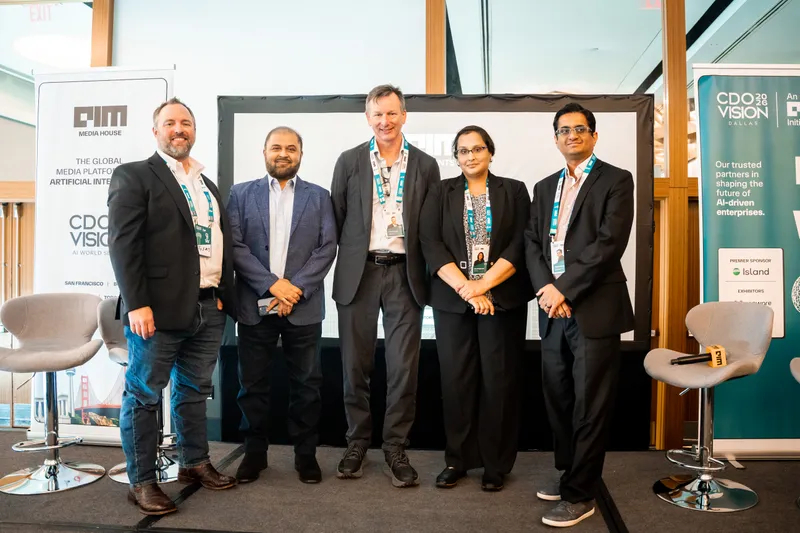
At CDO Vision Dallas 2026, the panel The Boardroom Conversation - How CXOs Shape AI Strategy focused on that gap. The panel was moderated by Ty East, Chief Information and Technology Officer at HomeVestors of America. Joining him on stage were Shuchi Agarwal, Head of AI Execution at SMBC Group; Moin Moinuddin, Chief Technology Officer at Xsolla; Ahmed Munir, Principal Enterprise Architect at Charter Communications - Spectrum Reach; and James Gaston, VP of Enterprise Data and Chief Data Officer at Parkland Health and Hospital System.

Ty East
Chief Information & Technology Officer, HomeVestors of America, Inc.
Moin Moinuddin
Chief Technology Officer, Xsolla
Ahmed Munir
Principal Architect, Charter Communications – Spectrum Reach
James Gaston
VP Enterprise Data & Chief Data Officer, Parkland Health and Hospital System01One AI strategy. three critical decisions
The opening exchanges established a framework that held throughout the panel. Across organisations of very different sizes and sectors, AI strategy consistently resolves into three distinct but interdependent decisions: how to improve internal productivity, how to make products and services better for customers, and how to innovate faster using the data the organisation already holds. Every panellist described their AI programme through some version of this structure, and every panellist also described the difficulty of executing all three simultaneously without losing discipline on any one of them.
The financial services leader offered the clearest articulation of the prioritisation challenge. Operating inside a large, legacy-heavy institution with a more conservative development capacity than a technology company, the strategic question is not what AI can do, it is where AI creates the highest return relative to the cost and risk of deployment.
Partner with CIO Vision
Reach the leaders this piece is about
Four or five partners per room, alongside 50–100 CIOs and enterprise AI leaders. Tell us who you want to meet.
The answer has three parts: enable the AI capabilities already embedded in existing enterprise software rather than building from scratch; make targeted investments in specialist external tools that would cost more to build internally; and continuously upskill the workforce so that learning becomes part of the organisation's operating rhythm rather than a periodic programme. None of these is a technology decision. All three are leadership decisions.
02Cultural resistance
Three of the four panellists described significant workforce resistance to AI adoption, and all three noted that the nature of the resistance varies considerably by geography, seniority, and sector. The technology company leader, operating without the legacy constraints of a bank or hospital, described a more aggressive adoption posture: AI usage by engineers is measured, published, and made transparent across the organisation, creating peer accountability alongside positive incentives such as dedicated mentoring, weekly AI office hours, and enterprise tool licences available to everyone. The result is 80% of engineers actively using AI tools, a figure most enterprises are nowhere near.
The banking leader described a different but equally intentional approach: monthly training cohorts that consistently fill to capacity, a champions community embedded across every division and department, and an incentive structure that turns AI proficiency into social currency and bragging rights as much as financial reward. The insight behind this is important. Mandating AI adoption tends to create compliance without engagement. Making AI adoption visible, social, and associated with genuine skill development creates something closer to a cultural shift. The banking leader's framing was precise: AI strategy requires continuous improvement. It is not a once-and-done implementation. The organisations treating it as a project to be completed rather than a capability to be built will find themselves starting over every 18 months.
03Governance sustains AI
The most pointed exchange of the afternoon came around the question of how CXOs lead organisational change when AI creates uncertainty about roles, ownership, and decision-making. The healthcare CDO described a conversation he had the previous day with his own team, thirty staff who had spent 14 years developing skills in systems that have now been sunset. Those skills are out of date. The new environment requires new capabilities. That conversation is not comfortable, but not having it is worse. The failure mode is not acknowledging the disruption. The failure mode is a thousand people across a 20,000-person organisation each independently creating AI agents with no governance, no oversight, no inventory, and no support, and those agents performing critical business functions that nobody has audited or can explain.
That image, the ungoverned agent proliferation scenario, landed visibly in the room. It is not hypothetical. Several organisations are already living with versions of it. The banking leader reinforced the point with a concrete illustration: a multi-agent system in logistics where one agent responding to a weather event triggered a cascade of misinterpretations across connected agents, resulting in significant inventory and supply chain disruption with no human in the loop to catch it. The lesson is not that agents are dangerous. The lesson is that agents operating without appropriate governance checkpoints can amplify a single bad decision across an entire system faster than any human organisation can correct it.
04Cxo priorities changed
The panel closed with a consensus that felt earned rather than rehearsed. The CXO's role in an AI-driven organisation is no longer primarily about technology decisions. It is about setting the culture, the governance framework, and the measurement discipline that determine whether AI initiatives produce durable business value or expensive, hard-to-unwind technical and organisational debt. The organisations getting this right are not necessarily the ones with the largest AI budgets or the most aggressive deployment timelines. They are the ones where the leadership team has been honest about the constraints, deliberate about the priorities, and rigorous about connecting AI investment to outcomes the business actually cares about. That is a leadership challenge. The technology is the easier part.
CDO Vision heads to San Francisco on 5 Jun 2026. If you lead Data or AI at an enterprise organisation, apply for your invitation at cdovision.aim.media. Seats are limited to 30+ senior leaders.
05About CDO vision global series 2026
CDO Vision is the world's leading intimate gathering series for Chief Data Officers, Chief Analytics Officers, and Chief Information Officers. Organised by AIM Media House since 2022, the 2026 Global Series spans 20 cities across 5 continents, bringing the world's most senior data and AI leaders together to share insights, strengthen networks, and shape the future of data-driven business. For more information, visit cdovision.aim.media or contact [email protected].
CIO summit Dallas · CIO summit San Francisco · Compare this with our AI conference for CIOs.