


Contents
The business case for AI is almost never the problem. Any team, in any organization, can build a compelling slide deck that justifies an AI investment. What they cannot always do is follow through, with clean data, real governance, honest problem scoping, and the organizational patience to close the gap between a promising pilot and something that actually works. That gap is where most enterprise AI goes to die. And it is exactly where the most important conversations in technology leadership are happening right now.
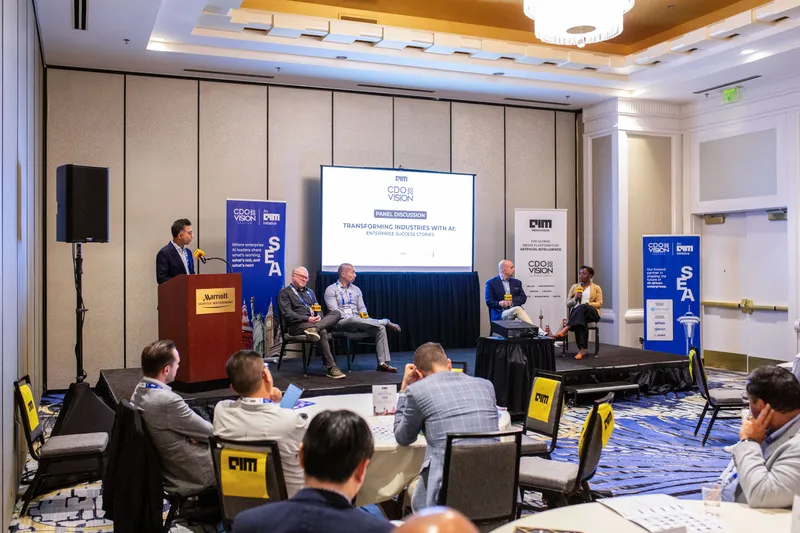
CDO Vision Seattle, part of the CDO Vision AI World Series, an intimate gathering that brings together 30+ senior data and technology leaders to move the conversation on AI from theory into practice. The Seattle edition drew executives from across healthcare, manufacturing, legal, and technology, people who are not watching AI from a distance but are in the middle of building, deploying, and managing it. The panel, titled Transforming Industries with AI: Enterprise Success Stories, was moderated by Naqi Khan, VP of Product for a Health AI Platform. He was joined by Ken Johnston, VP of AI at Envorso; Christopher Tan, Vice President of Legal AI at R1 RCM; Bradd Busick, Principal of AI, Data and Technology Enablement at Frazier Healthcare Partners; and Aisha Kaba, Head of AI Solutions at PACCAR Powertrain. Together, they brought perspectives from industries where the stakes of getting AI wrong range from financial loss to patient harm.

Naqi Khan
VP Product, Health AI Platform, MCG Health
Ken Johnston
VP of AI, Envorso
Christopher Tan
Vice President, Legal AI, R1 RCM
Bradd Busick
Principal, AI, Data & Technology Enablement, Frazier Healthcare PartnersThree themes emerged from the conversation that cut across every sector represented on stage.
01The distance between a pilot and production is longer than most people think
Everyone on the panel had lived through the early excitement of an AI pilot. Ken Johnston described a multi-year effort at an automotive organization to combine structured vehicle data with unstructured dealership notes, handwritten records, short video clips, field observations, to identify warranty risks before they became costly failures. The breakthrough eventually came, including tracing a mechanical defect back to a lapse in equipment maintenance that had gone unaddressed for years. But it did not come quickly.
Partner with CIO Vision
Reach the leaders this piece is about
Four or five partners per room, alongside 50–100 CIOs and enterprise AI leaders. Tell us who you want to meet.
“We honestly failed probably for the first two years until we finally organized the data correctly,”
Christopher Tan reframed the pilot question entirely. Rather than asking what it takes to succeed, he argued organizations should start by asking how not to fail. The business case, he pointed out, is almost never the problem. "It's easy to make the business case for any of these solutions," he said. The harder work is understanding the problem deeply enough before you reach for a solution, mapping the data, the dependencies, the gaps. In healthcare especially, where records are messy and highly individualized, assuming a clean solution will map cleanly onto unclean data is a recipe for failure.
Ken Johnston introduced a phrase that resonated throughout the rest of the session: prototype theater. It describes a pattern that has become increasingly common, where AI tools are used to rapidly generate something that looks like a product, demos are run, everyone gets excited, and a decision is made to ship before any of the foundational work has been done. No governance pipeline. No version control. No alignment to what the business actually needs. "Less than one in five prototypes get to production," Johnston said,
“because again, it's not even aligned with business priorities.”
02Governance is not a document. It is an operating system
If prototype theater describes how organizations rush in, governance theater describes how they pretend to be responsible. Several panelists pointed to a pattern where governance exists on paper, a checklist, a policy PDF, a committee, but is never embedded into how systems are actually built and deployed.
Johnston raised a striking legal case involving a health insurer that defended itself against an AI-related lawsuit by pointing to human oversight of its decisions. When asked to produce logs, it emerged that reviewers were spending an average of just over a second per case. "You can't pretend to have governance," Johnston said, "and you can't automate governance."
Bradd Busick brought a private equity lens to the same problem. When acquiring healthcare companies, he frequently encounters organizations running on outdated infrastructure with no meaningful governance in place, and yet those companies are delivering care to real patients. The answer, he argued, is not to treat governance as a burden imposed from outside but as something built collaboratively. "It's not done to us," he said. "It's done with us."
That transition requires its own governance
- Just of the technology, but of the organization around it
03Adoption follows trust, and trust follows genuine usefulness
Aisha Kaba identified fear of obsolescence as one of the most persistent sources of friction in rolling out AI. Even when a tool is designed to augment rather than replace, employees often experience it as a threat. That resistance shapes what gets shared, what gets disclosed, and ultimately what gets built.
The counterweight to that fear, the panel suggested, is visible, tangible benefit. Busick described the impact of ambient AI tools in clinical settings, tools that handle documentation automatically so that practitioners can be fully present with patients. The response from people using those tools was not reluctant acceptance. It was relief. "If today's the worst it's ever going to be," Busick said, "I'm wildly bullish on where it's about to go."
Naqi Khan closed with a simple metric for knowing when something has genuinely crossed over from pilot to real: when people outside your industry start talking about it without prompting. Adoption, he argued, is the ultimate proof of value.
The panel at CDO Vision Seattle did not offer a formula for AI success. What it offered was something more useful, a practitioner's account of what discipline, humility, and honest problem-scoping actually look like in organizations where AI is not a strategy slide but a daily operational reality. The gap between ambition and maturity is real. Closing it requires less theater and more infrastructure, and the willingness to do the unglamorous work that makes the glamorous outcomes possible.
CIO summit Seattle · Compare this with our AI conference for CIOs.