Contents
A telecom software maker, a global ad agency, a gym franchisor and an HR platform compared notes on what it really takes to move AI from experiment to everyday operations. Their answers had little to do with models and a lot to do with people, data and money.
Most enterprises have stopped asking whether AI works. The harder question now is how to make it work across thousands of employees, hundreds of business partners and a cost base that has to make sense to the CFO.

Mayoran Rajendra
General Manager, AI Transformation Dept., SMBC Group
Ahmad Farid
Vice President - AI-Nization, Rakuten Symphony
Yoshimichi Matsumura
Data Analytics Director, McCann
Fidens Simanjuntak
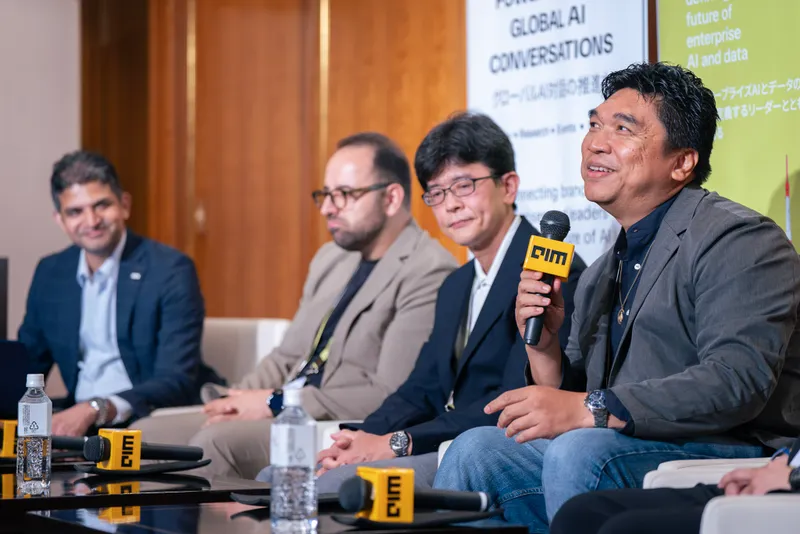
Director of Data and Digital Product, Fast Fitness JapanThat was the brief for a panel on implementing and scaling AI in the enterprise, held at a boardroom gathering of senior technology leaders in Tokyo. It was moderated by Mayoran Rajendra, General Manager of the AI Transformation Department at SMBC Group. He framed the session in two rounds: what is working, and what comes next.
01The panel was:
- Ahmad Farid, Vice President, AI-Nization, Rakuten Symphony
- Yoshimichi Matsumura, Data Analytics Director, McCann
- Fidens Simanjuntak, Director of Data and Digital Product, Fast Fitness Japan
- Jumpei Okamoto, Senior Executive Manager, Technology Division and Data AI Solutions Division, PERSOL CAREER
The four companies could hardly be more different. That is what made the overlap in their lessons so striking.
Partner with The CIO Room
Reach the leaders this piece is about
Four or five partners per room, alongside 50–100 CIOs and enterprise AI leaders. Tell us who you want to meet.
Rakuten Symphony: when AI strategy and business strategy are the same document
Rakuten Symphony spends roughly $1.50 on AI tokens for every $7.50 of value it gets back. Farid admitted the number was "almost unbelievable" when the team first worked it out.
The company was founded in 2021 out of the build of Rakuten Mobile, Japan's fourth mobile carrier. Rakuten Mobile runs on open standards (ETSI and Open RAN), which separate network hardware from software. That design makes automation possible, and Rakuten Symphony grew out of the technology built to deploy it. In Farid's words, the company had a jump start on AI because automation was already in its DNA.
At Rakuten Group, AI is treated as seriously as the group's earlier big bets: adopting English as its business language, moving into fintech and launching a mobile network. The group began its AI-nization program in 2023 with a "triple 20" target: a 20% productivity gain in sales and marketing, in operations, and for customers. Farid said Rakuten Symphony passed that bar within about 18 months. He also leads strategy at the company, and said its business strategy and AI strategy are now "all in one."
02The company works on three fronts:
Using AI to run its own business, which is mostly software development and engineering
Embedding AI into its existing product suite
Building AI-native products to take to market
The adoption figures are high. Between 90% and 95% of employees use AI weekly or monthly, and about 70% of their workflows include some AI, from knowledge search and document review to coding and QA. Development and QA account for 70% to 80% of token consumption.
The flagship customer use case runs on Rakuten Mobile's network. Rakuten Symphony's RAN Intelligent Controller includes a feature called auto-compensation. Trained over a long period on network and user KPIs, it predicts when a cell site is likely to fail. It then adjusts the remote electric tilt of nearby antennas so users in that area keep their coverage.
Mayoran drew a lesson for traditional enterprises from this. SMBC, he noted, is also using AI for software development and system modernization. In his view, that kind of work, along with failure prediction that blends time-series and qualitative data, delivers more value than chat interfaces.
McCann: getting your brand into the AI's answer
After McCann deployed its generative engine optimization (GEO) tool, some of its clients saw their brand mention rate rise to almost 30%.
Matsumura spent nearly 20 years in consulting and is a Six Sigma Master Black Belt and former PMO director. He described a problem every consumer-facing brand now faces. Google's AI Overviews appear above standard search results in around 50% of searches on average, and in up to 80% for some keyword types. Many users read the overview and never click the links underneath it.
For marketers, the goal has shifted from ranking on a results page to being named in the AI's answer. McCann built a tool that tracks how often a brand or website is mentioned in AI-generated responses.
Mayoran said SMBC, with its large retail presence, is grappling with the same question, and asked what enterprises can actually do. Matsumura pointed to two levers:
- Structure: organize the website with structured HTML so AI systems can parse it
- Content: write content in a way that AI engines are more likely to select and cite
Mayoran's takeaway was that producing the right content will become more important, and more difficult, for every enterprise.
Fast Fitness Japan: AI adoption without a chain of command
Fidens Simanjuntak cannot order anyone to use AI. Fast Fitness Japan is the master franchisee of Anytime Fitness in Japan and Germany. It has about 1,300 clubs and 1.2 million members, but runs only around 200 of those clubs itself. The rest belong to about 180 franchise companies. "I'm not dealing only with one CEO," he said, "but with 180 CEOs."
He joked that he had more war stories than success stories. His approach has been to roll AI out in rings: headquarters first, then corporate-run clubs, then franchisees. Because the business wins on operational excellence, every tool has to make daily operations work better.
The first step was governance. When generative AI took off, staff were using ChatGPT, Gemini, Copilot and others side by side. Concerned about data leaks and brand risk, the team quickly wrote an AI guideline. It standardized on Gemini, which fit the company's Google Workspace setup, and blocked other generative AI services.
The second step was leading by example. In a meeting about club locations, Fidens pasted a Google Maps screenshot into Gemini and pulled out competitor insights on the spot. Soon a colleague mentioned he was using Gemini to analyze a survey. "We're seeing, qualitatively, people start using it to speed up their work," he said.
Mayoran called this a refreshing contrast to large-enterprise adoption talk. A small owner running three gyms in a regional city has no reason to care about AI. A concrete example tied to their own competitors, he said, gives them one.
PERSOL CAREER: AI on both sides of the hiring market
After PERSOL CAREER launched AI-assisted CV creation for job seekers, usage of the service rose to 125% and revenue to 105%. Jumpei Okamoto spoke in Japanese, and Mayoran summarized his remarks in English.
PERSOL CAREER runs doda, one of Japan's best-known career and job-search brands. Over the past two to three years it has applied AI both internally and in customer-facing services, working on each side of the hiring market:
- Candidates: AI helps job seekers write their CVs
- Employers: AI agents now handle much of the work of collecting job descriptions and building job postings, a process that used to rely heavily on outsourcing
Because recruiting involves large volumes of personal information, PERSOL CAREER built its AI capability in-house on Azure using OpenAI models. Data protection and leak prevention are core to the design.
Okamoto also described a challenge many leaders in the room recognized. AI is now part of day-to-day work, but management expects more. The question has moved from "how do we use AI" to "how does AI transform our business model."
What comes next: cheaper, deeper, more native
When Mayoran asked each panelist what comes next, none of them said "more pilots." Each answer pointed to a different limit on scaling.
Is quality: cutting back to the use cases that genuinely add value. The
Is efficiency. Commercial AI coding tools get very expensive at scale, so the team is testing in-house code-generation tools built on Rakuten's own language models. It also wants its AI Workbench platform to work for a mid-sized enterprise as well as a national mobile network. The
Is scalability. A mobile operator may run hundreds or thousands of edge sites without GPUs, so the team is experimenting with small language models that run on CPUs
McCann is turning AI on its own work. Beyond rolling out the GEO tool more widely, Matsumura's team built an AI analytics tool that cut work taking several days to a week down to a few minutes. The plan is to apply AI to more of the agency's own workflows.
Fast Fitness Japan is learning that the model is the easy part. Fidens is building a data foundation covering members, clubs, machine locations and club sizes. On top of that, his team built an in-house CRM and marketing automation platform in three months. It sends mass emails that drive members to the company's e-commerce business, and engagement-based segmentation and personalized journeys are next. The team also has a churn prediction model that is 80% accurate. Deploying it is the hard part: when club staff learn who is likely to quit, they don't know what to do about it. "Creating a model is the easy part," he said; the gap is operations and workforce education. AI cameras in clubs are on the list too, which means convincing 180 franchise owners to buy them.
PERSOL CAREER is building for AI-native operations. Okamoto's goal is to make operations AI-native. That starts with the foundations: infrastructure, data governance and security.
Five lessons for technology leaders
The four companies work in different industries, but scaling AI tested them in similar ways.
- Tie AI to the core strategy, not a side program. Rakuten's AI-nization sits alongside its biggest past bets, and its "triple 20" target made progress measurable from the start.
- Measure ROI, then look past cost savings. Token-to-value ratios are a useful start. Farid said the next step is business metrics that capture productivity, not only efficiency.
- Governance comes before adoption. Fast Fitness Japan's guideline and PERSOL CAREER's private Azure build both put data protection first, and adoption grew on that base.
- Show, don't mandate. When leaders can't order people to adopt AI, a concrete example tied to someone's own work does more than any rollout memo.
- Deployment is harder than modelling. An 80%-accurate churn model creates no value until frontline staff know what to do with what it tells them.
As Mayoran noted in closing, the panel ran from AI-driven, software-defined networks to marketing, retail franchising and HR. All four were working through the same shift: from using AI in day-to-day work to rebuilding the business around it.
Join the conversation at The CIO Room
This discussion came from The CIO Room, an invite-only boardroom series where senior CIOs, CDOs and AI leaders swap candid, practical lessons on scaling data and AI. Sessions run in more than 20 cities worldwide.
Are you a technology leader? Request an invitation to an upcoming boardroom near you at thecioroom.com.
Are you a solutions provider? Partnering with The CIO Room puts your team in small, closed-door sessions with the enterprise leaders who make AI decisions. Explore sponsorship opportunities at thecioroom.com.
CIO summit Tokyo · Compare this with our AI conference for CIOs.